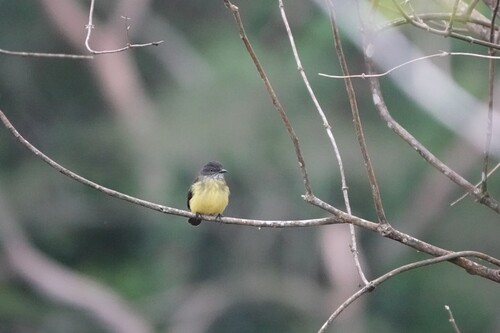
Dusky-chested Flycatcher
Myiozetetes luteiventris
The dusky-chested flycatcher is the smallest member of genus Myiozetetes. It is 14 to 15 cm (5.5 to 5.9 in) long and weighs about 16.5 g (0.58 oz). The sexes have almost the same plumage. Adult males of the nominate subspecies have a grayish olive-brown crown and face with a mostly hidden yellow-orange patch in the center of the crown. Females have a smaller patch or none at all. Adults of both sexes have dark olive-brown upperparts. Their wings are dark olive-brown with faint and variable rufous edges on the flight feathers. Their throat is whitish with faint dusky streaks. Voice: The dusky-chested flycatcher's most common call is "a nasal, cat-like meeow or softer neea". It makes a "fast nasal nyeeuw-nyeeuw, keep-kít or neea-ne-wít" when it is excited; sometimes pairs do this in duet. It also makes simple, often repeated, "keeuw or nyeeuw" calls.
ID text from Wikipedia, CC BY-SA 4.0


Grey-capped Flycatcher
Myiozetetes granadensis
The grey-capped flycatcher is 16 to 18 cm (6.3 to 7.1 in) long and weighs 28 to 30 g (0.99 to 1.1 oz). The sexes have almost the same plumage. Adult males of the nominate subspecies have a gray crown and nape with a mostly hidden orange-yellow to reddish orange patch in the center of the crown. Females sometimes have a smaller patch or none at all. Adults of both sexes have a white forehead that extends as a thin supercilium to just past the eye. They have dusky lores and ear coverts. Their upperparts are mostly olive-green with dusky to dark olive uppertail coverts that have paler edges. Voice: The grey-capped flycatcher's vocalizations appear to vary somewhat across its range. In Ecuador west of the Andes its dawn song is a "kip, ki[p, kip, keeuw-kreh" that lasts about two or three seconds. East of the Andes it sings "a faster kip, kip, kip, kip, kip, kip, ke-ke-kree-yí" that lasts one or two seconds. Its Central American song is written as a "high djup-djup sréeeh".
ID text from Wikipedia, CC BY-SA 4.0

Where you might meet both
Learn this pair in the BeakBrain App
Photo and call practice. Coming soon to iPhone and Android.
Play today's Daily BirdPhotos and recordings are credited to their authors under the licence shown. Full profiles: Dusky-chested Flycatcher and Grey-capped Flycatcher.