
Cuban Pewee
Contopus caribaeus
The Cuban pewee is 15 to 16.5 cm (5.9 to 6.5 in) long and weighs 8.5 to 13.5 g (0.30 to 0.48 oz). The sexes have the same plumage. Adults of the nominate subspecies C. c. caribaeus have a dark olive-gray crown with a slight crest, slightly paler olive-gray lores, and a whitish crescent around the back of the eye on an otherwise olive-brown face. Their back is also olive-brown. Their wings are dusky brown with pale tips on the coverts that show as two faint wing bars. The wing's outer secondaries and tertials have whitish edges. Their tail is dusky. Voice: The dawn song of the Cuban pewee's nominate subspecies is "a high squeaky whistle, eeah, ooweeah, usually given sequentially". That of C. c. bahamensis adds a "dee-dee" phrase to the end of the same song. During the day the species sings "a prolonged descending weeeooooo". Its calls are "a repeated weet or dee softer dep or vi-vi notes".
ID text from Wikipedia, CC BY-SA 4.0
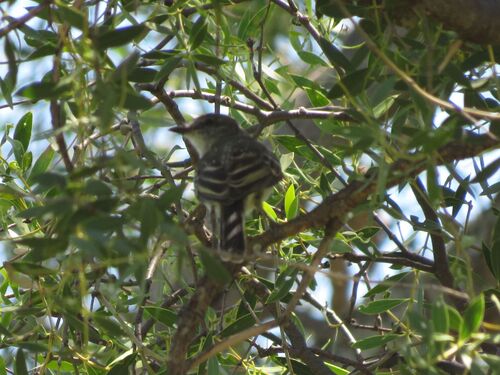
Suiriri Flycatcher
Suiriri suiriri
The suiriri flycatcher is 15 to 16 cm (5.9 to 6.3 in) long. The nominate subspecies weighs 11.5 to 16 g (0.41 to 0.56 oz) and subspecies S. s. burmeisteri 18.5 to 21 g (0.65 to 0.74 oz). It is a medium-sized flycatcher. The sexes have the same plumage. Adults of the nominate subspecies have a gray crown and nape. They have a white spot behind the lores and a short white supercilium on an otherwise whitish face. Their upperparts are gray. Their wings are a darker gray with paler outer edges and tips on the flight feathers. Voice: The vocalizations of the nominate and bahiae subspecies are not well documented but appear to be essentially the same. Their most common call is "a single nasal 'rowl' or 'jyow' ". Subspecies S. s. burmeisteri pairs sing in duet. Males sing "a series of sneezy 'pi-chew' notes, variable in length, typically begins with several squeaky notes and ends with several monosyllabic 'chew' notes".
ID text from Wikipedia, CC BY-SA 4.0
Learn this pair in the BeakBrain App
Photo and call practice. Coming soon to iPhone and Android.
Play today's Daily BirdPhotos and recordings are credited to their authors under the licence shown. Full profiles: Cuban Pewee and Suiriri Flycatcher.