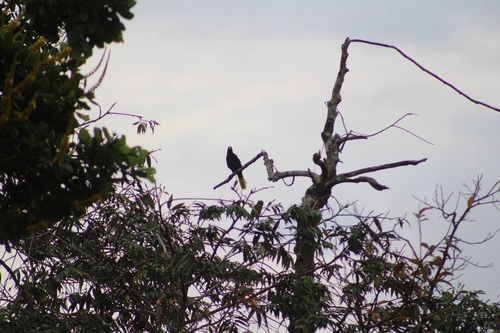
Crested Oropendola
Psarocolius decumanus
Male crested oropendolas of the nominate subspecies P. d. decumanus average 47 cm (19 in) long and females 37 cm (15 in). Males weigh about 285 g (10 oz) and females about 160 g (5.6 oz). Adult males have long feathers on their nape that form a crest. They are mostly a slightly glossy black with a chesnut rump, uppertail coverts, and undertail coverts. Their central pair of tail feathers are black and the rest yellow. Adult females are overall duller than males; they are brownish tinged rather than pure black and have a minimal crest. Voice: The male crested oropendola's display song "usually starts with low-pitched liquid notes, accelerates into variable and complex rattling crescendo, and ends with 2–3 seconds of rhythmic wing-flaps". One description calls it "very complex, including very high, rapid, staccato flutes and liquid curls".
ID text from Wikipedia, CC BY-SA 4.0

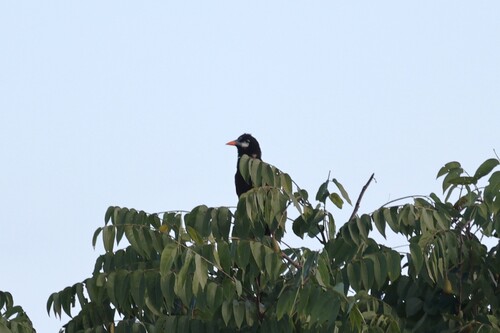
Montezuma Oropendola
Psarocolius montezuma
Adult males are mainly chestnut with a blackish head and rump, and a tail which is bright yellow apart from two dark central feathers. There is a bare blue cheek patch and a pink wattle, the iris is brown, and the long bill is black at the base with a red tip. Females are similar, but smaller than males with a smaller wattle. Young birds are duller than adults and have a paler and less demarcated bill. No subspecies are currently recognized. Voice: The "unforgettable" song of the male Montezuma oropendola is given during the bowing display, and consists of a conversational bubbling followed by loud gurgles, tic-tic-glik-glak-GLUUuuuuu. Both sexes have loud cack and crrrk calls. In a recent study by on male Montezuma oropendolas, researchers found that, when at breeding sites, males often changed the lowest peak frequency.
ID text from Wikipedia, CC BY-SA 4.0
Where you might meet both
Learn this pair in the BeakBrain App
Photo and call practice. Coming soon to iPhone and Android.
Play today's Daily BirdPhotos and recordings are credited to their authors under the licence shown. Full profiles: Crested Oropendola and Montezuma Oropendola.