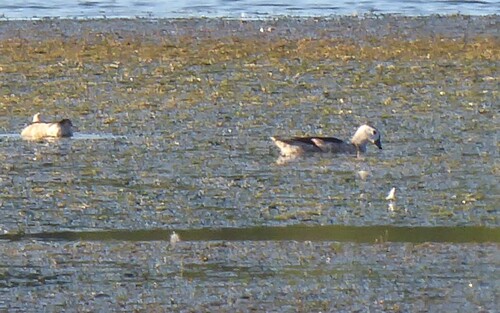
Cotton Pygmy Goose
Nettapus coromandelianus
Small individuals of this species are the smallest waterfowl on earth, at as little as 160 g (5.6 oz) and 26 cm (10 in). The goose-like bill is short and deep at the base. Males have a dark brown forehead and crown and a blackish green broad collar at the base of the neck. The sides of the head and neck are whitish. The back, wing coverts and scapulars are dark brown with green and purple gloss. The female has a duller cap and a brown line through the eye. The collar is replaced by spots and the face is flecked and neck finely vermiculated unlike the male.
ID text from Wikipedia, CC BY-SA 4.0
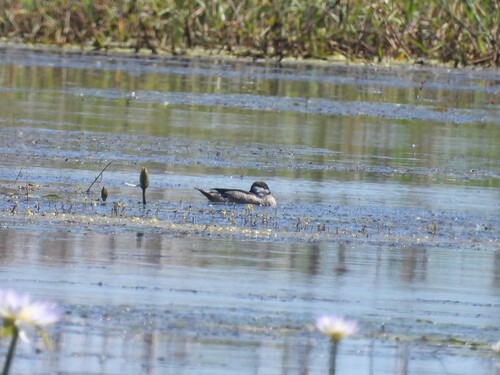
Green Pygmy Goose
Nettapus pulchellus
Ranging from 30 to 36 cm (12 to 14 in) in length, the green pygmy goose is one of the smallest species of duck. It has a 48 to 60 cm (19 to 23.5 in) wingspan. It has a small bill and a compact form. The breeding male has a predominantly dark green back and neck, and a dark gray crown. The cheeks are white, and the underparts are pale grey and white scalloped. The tail, primary flight feathers and primary coverts are black, while the secondary flight feathers are white. The secondary coverts are a dark iridescent green.
ID text from Wikipedia, CC BY-SA 4.0
Where you might meet both
Learn this pair in the BeakBrain App
Photo and call practice. Coming soon to iPhone and Android.
Play today's Daily BirdPhotos and recordings are credited to their authors under the licence shown. Full profiles: Cotton Pygmy Goose and Green Pygmy Goose.