
Cordilleran Canastero
Asthenes modesta
The cordilleran canastero is 15 to 16 cm (5.9 to 6.3 in) long and weighs 13 to 22 g (0.46 to 0.78 oz). It is one of the smaller canasteros. The sexes have the same plumage. Adults of the nominate subspecies A. m. modesta have a narrow light buff-brown supercilium, dark brownish lores, brownish ear coverts, and a whitish buff-brown malar region with darker brown streaks. Their crown, nape, back, rump, and uppertail coverts are dull dark brown, though the back is paler and sandier in the southern part of the species' range. Voice: The cordilleran canastero's song is "an ascending fast trill that ends abruptly". It also makes a "more complex trill with introductory notes". Its calls are "a short, low 'pyup' or 'tjit' ".
ID text from Wikipedia, CC BY-SA 4.0
Many-striped Canastero
Asthenes flammulata
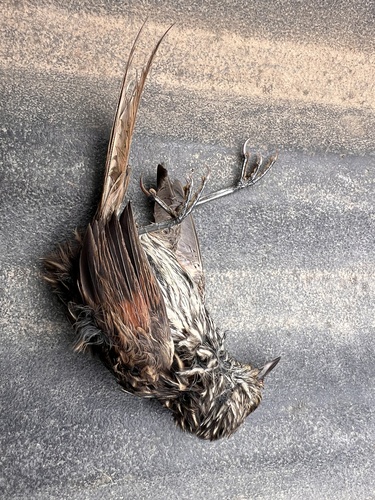
The many-striped canastero is 16 to 17 cm (6.3 to 6.7 in) long and weighs 17 to 27 g (0.60 to 0.95 oz). It is a large canastero and the most dramatically striped of them. The sexes have the same plumage. Adults of the nominate subspecies have a buff-whitish supercilium on an otherwise dark brownish face with buff to whitish streaks. Their forehead is bright tawny-brown or rufescent brown with dark brown stripes that widen to become the brown crown with rufescent streaks. Their upperparts from back to uppertail coverts are dark brown with conspicuous pale buff streaks. Voice: The many-striped canastero's song is an "accelerating series of buzzy notes that initially rises in pitch, and towards the end smoothly changes into a stuttering descending trill tzee-tzee-tzee-tzeetzeetzetztztztzrrrrrrr". It typically sings from a perch atop a shrub, and sometimes two birds countersing. The song differs little among the subspecies.
ID text from Wikipedia, CC BY-SA 4.0

Where you might meet both
Learn this pair in the BeakBrain App
Photo and call practice. Coming soon to iPhone and Android.
Play today's Daily BirdPhotos and recordings are credited to their authors under the licence shown. Full profiles: Cordilleran Canastero and Many-striped Canastero.