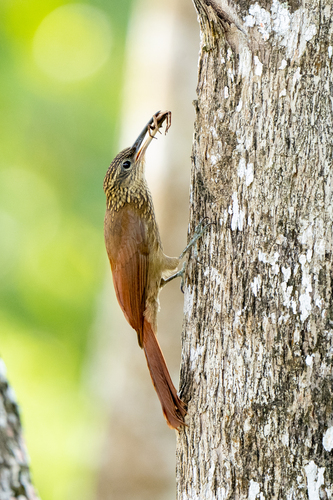
Cocoa Woodcreeper
Xiphorhynchus susurrans
The cocoa woodcreeper is 21 to 25.5 cm (8.3 to 10 in) long and weighs 43 to 58 g (1.5 to 2.0 oz). It is a medium-sized member of genus Xiphorhynchus, with a long, fairly heavy, slightly decurved bill. The sexes have the same plumage. Adults of the nominate subspecies X. s. susurrans have a mostly dusky face with buff streaks and a whitish supercilium. Their crown and nape are dark brown to blackish with longish buff spots that are streakier on the neck and nape. Voice: The cocoa woodcreeper is quite vocal; during the breeding seasons it sings for long periods at dawn and dusk and sometimes during much of the day. Its song is "a loud series of 7-20 (often 7-8) clear but upward-inflected whistles...either be on the same pitch or beginning fast and rising slightly, before fading and descending, e.g., ki, ki, kuee, kuee, whe, whew, whew, whew, whew.
ID text from Wikipedia, CC BY-SA 4.0

Olivaceous Woodcreeper
Sittasomus griseicapillus
The olivaceous woodcreeper is one of the smallest members of its subfamily. It has a slim body and a short straight bill, and unlike most other woodcreepers has no streaks or spots. The sexes' plumages are alike but females average smaller than males. Adults are 13.1 to 19.3 cm (5.2 to 7.6 in) long. Males weigh 9.0 to 18.0 g (0.32 to 0.63 oz) and females 8.6 to 16.0 g (0.30 to 0.56 oz). Length and weight vary geographically. All subspecies have a dark iris, a dark gray to black maxilla, a black to light gray mandible with a darker tip, and gray, bluish gray, or black legs and feet. Voice: The olivaceous woodcreeper's vocalizations vary widely across the subspecies. There are at least six song types and can be sorted into two groups. Subspecies in Middle America, northern South America, and west of the Andes make "a rapid staccato trill or thin rattle". Those in Amazonia and eastern and southeastern Brazil make "a rapid, alternating series of clear whistles". The song of S. g.
ID text from Wikipedia, CC BY-SA 4.0

Where you might meet both
Learn this pair in the BeakBrain App
Photo and call practice. Coming soon to iPhone and Android.
Play today's Daily BirdPhotos and recordings are credited to their authors under the licence shown. Full profiles: Cocoa Woodcreeper and Olivaceous Woodcreeper.