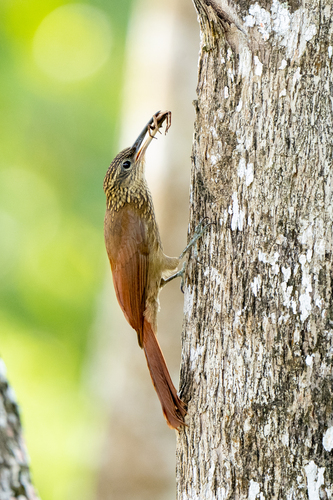
Cocoa Woodcreeper
Xiphorhynchus susurrans
The cocoa woodcreeper is 21 to 25.5 cm (8.3 to 10 in) long and weighs 43 to 58 g (1.5 to 2.0 oz). It is a medium-sized member of genus Xiphorhynchus, with a long, fairly heavy, slightly decurved bill. The sexes have the same plumage. Adults of the nominate subspecies X. s. susurrans have a mostly dusky face with buff streaks and a whitish supercilium. Their crown and nape are dark brown to blackish with longish buff spots that are streakier on the neck and nape. Voice: The cocoa woodcreeper is quite vocal; during the breeding seasons it sings for long periods at dawn and dusk and sometimes during much of the day. Its song is "a loud series of 7-20 (often 7-8) clear but upward-inflected whistles...either be on the same pitch or beginning fast and rising slightly, before fading and descending, e.g., ki, ki, kuee, kuee, whe, whew, whew, whew, whew.
ID text from Wikipedia, CC BY-SA 4.0
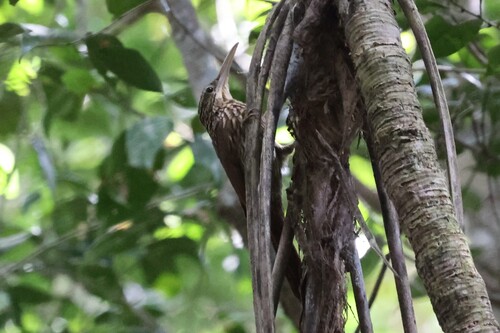
Ivory-billed Woodcreeper
Xiphorhynchus flavigaster
The ivory-billed woodcreeper is 20 to 26.5 cm (7.9 to 10 in) long. Males weigh 40 to 62 g (1.4 to 2.2 oz) and females 35 to 56 g (1.2 to 2.0 oz). It is a medium-sized member of genus Xiphorhynchus, with a long, fairly heavy, slightly decurved bill. The sexes have the same plumage. Adults of the nominate subspecies X. f. flavigaster have a face with fine buffy and blackish streaks, an indistinct buffy supercilium and eyering, and a faint dark stripe behind the eye. Their crown and nape are dark grayish brown with longish buff spots that are almost streaks. Voice: The ivory-billed woodcreeper's song in western Mexico is "piercing whistles in loud cascade that first ascends slightly and increases in volume before descending and slowing, 't-t-t-ttttttttt-t-tewtewtew-tew-tew' ". In northern Central America it is "a rapid trill, descending slightly in pitch at end" and in Costa Rica "a loud, laughing, descending whinny.
ID text from Wikipedia, CC BY-SA 4.0

Where you might meet both
Learn this pair in the BeakBrain App
Photo and call practice. Coming soon to iPhone and Android.
Play today's Daily BirdPhotos and recordings are credited to their authors under the licence shown. Full profiles: Cocoa Woodcreeper and Ivory-billed Woodcreeper.