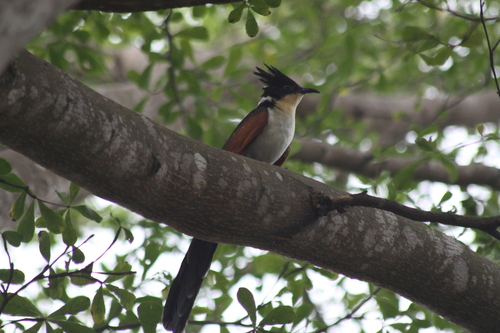
Chestnut-winged Cuckoo
Clamator coromandus
This dark and crested cuckoo has chestnut wings, a glossy black crest and a graduated tail (the feathers shortening in steps from the center outwards) whose terminal edges are white and inconspicuous unlike the white tips of the Jacobin cuckoo which is found in parts of its range. The black capping on the head is broken from black of the back by a white collar that extends to the sides of the neck. The lower parts are rufous turning to dark grey towards the vent. Young birds are dusky with a scaly appearance to the wing feathers.
ID text from Wikipedia, CC BY-SA 4.0

Great Spotted Cuckoo
Clamator glandarius
This species is slightly larger than the common cuckoo at 35–39 cm (14–15 in) in length, but looks much larger with its broad wings and long narrow tail. The adult is grey above with a slender body, long tail and strong legs. It has a grey cap, grey wings, a yellowish face and upper breast, and white underparts. Sexes are similar. The juveniles have blackish upperparts and cap, and chestnut primary wing feathers. This species has a magpie-like flight. It is a bird of warm open country with trees.
ID text from Wikipedia, CC BY-SA 4.0

Learn this pair in the BeakBrain App
Photo and call practice. Coming soon to iPhone and Android.
Play today's Daily BirdPhotos and recordings are credited to their authors under the licence shown. Full profiles: Chestnut-winged Cuckoo and Great Spotted Cuckoo.