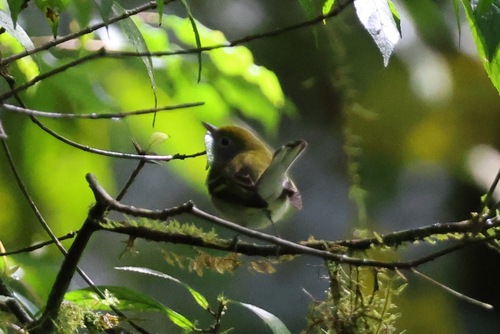
Chestnut-sided Warbler
Setophaga pensylvanica
This species is a moderately-sized New World warbler. Despite having very different plumage, it is thought to be closely related to the widespread yellow warbler. In total, this species measures from 10 to 14 cm (3.9 to 5.5 in) in length and spans 16 to 21 cm (6.3 to 8.3 in) across the wings. Body weight ranges from 8 to 13.1 g (0.28 to 0.46 oz). Among standard measurements, the wing chord is 5.7 to 6.8 cm (2.2 to 2.7 in), the tail is 4.2 to 5.8 cm (1.7 to 2.3 in), the bill is 0.9 to 1 cm (0.35 to 0.39 in) and the tarsus is 1.7 to 1.9 cm (0.67 to 0.75 in). Voice: The songs are high whistled lines often described as pleased, pleased, pleased to MEECHA. This accented song is used primarily to attract a female and decrease in frequency once nesting is well under way. Males also sing unaccented songs (without the MEECHA at the end) and these are used mostly in territory defense and aggressive encounters with other males.
ID text from Wikipedia, CC BY-SA 4.0

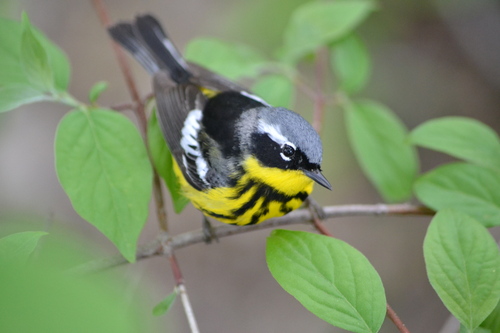
Magnolia Warbler
Setophaga magnolia
This species is a moderately small New World warbler. It measures 11 to 13 cm (4.3 to 5.1 in) in length and spans 16 to 20 cm (6.3 to 7.9 in) across the wings. Body mass in adult birds can range from 6.6 to 12.6 g (0.23 to 0.44 oz), though weights have reportedly ranged up to 15 g (0.53 oz) prior to migration. Among standard measurements, the wing chord is 5.4 to 6.4 cm (2.1 to 2.5 in), the tail is 4.6 to 5.2 cm (1.8 to 2.0 in), the bill is 0.8 to 1 cm (0.31 to 0.39 in) and the tarsus is 1.7 to 1.85 cm (0.67 to 0.73 in). The magnolia warbler can be distinguished by its coloration. Voice: Researchers have observed two different types of songs in male magnolia warblers. Their songs have been referred to as the First Category song and the Second Category song. These songs have two distinct purposes – one used to attract mates, and the other to defend territory. Females, while they do sing, have not been observed to have separate songs for different situations.
ID text from Wikipedia, CC BY-SA 4.0

Where you might meet both
And 2 more countries.
Learn this pair in the BeakBrain App
Photo and call practice. Coming soon to iPhone and Android.
Play today's Daily BirdPhotos and recordings are credited to their authors under the licence shown. Full profiles: Chestnut-sided Warbler and Magnolia Warbler.