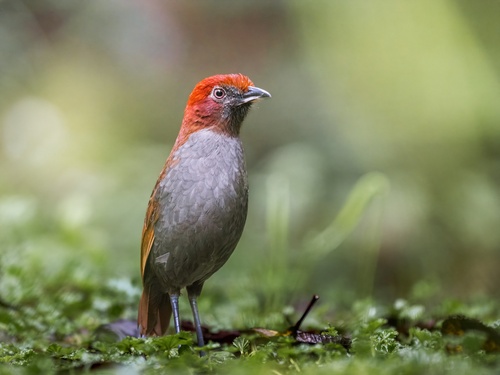
Chestnut-naped Antpitta
Grallaria nuchalis
Grallaria antpittas are a "wonderful group of plump and round antbirds whose feathers are often fluffed up...they have stout bills very short tails". The chestnut-naped antpitta is 19.5 to 21 cm (7.7 to 8.3 in) long and weighs 104 to 122 g (3.7 to 4.3 oz). There is no plumage difference of the male and female. Adults of the nominate subspecies have a dark chestnut crown and a rufous-chestnut hindcrown, nape, and face. They have gray lores and a patch of bare white skin behind the eye. Their upperparts and tail are brown. Their wings are mostly brown with tawny-brown primaries. Voice: The chestnut-naped antpitta sings mostly at dawn and dusk, and usually from a hidden low perch. Its "distinctive and often-heard song a series of 4-7 well-enunciated and emphatic whistled notes, the first set all similar but the last long and sharply upslurred, e.g. 'keeu, kew-kew-kew k-wheeeei?'".
ID text from Wikipedia, CC BY-SA 4.0


Tawny Antpitta
Grallaria quitensis
The tawny antpitta is 16 to 18 cm (6.3 to 7.1 in) long and weighs between 58 and 81 g (2.0 and 2.9 oz). The sexes have the same plumage. Adults have pale buff lores and are whitish around the eye on an otherwise olive brown to rufous olive face. They have mostly pale brown to olive brown crown, nape, back, wings, and tail. Their crown and back have a slight gray wash and their rump is browner, almost clay-colored. Their primaries have pale buff leading edges and blackish to blackish olive trailing vanes. Their chin and throat are whitish. Voice: Despite its generally open habitat, the tawny antpitta is more often heard than seen. Its basic song is "a simple, three-note vocalization that starts with a short, even, overslurred note followed by a pause, and then two slightly longer overslurred notes at a slightly lower pitch in quick succession" that lasts about 1.1 to 1.3 seconds.
ID text from Wikipedia, CC BY-SA 4.0

Where you might meet both
Learn this pair in the BeakBrain App
Photo and call practice. Coming soon to iPhone and Android.
Play today's Daily BirdPhotos and recordings are credited to their authors under the licence shown. Full profiles: Chestnut-naped Antpitta and Tawny Antpitta.