
Chestnut-crowned Becard
Pachyramphus castaneus
The chestnut-crowned becard is about 14 to 15 cm (5.5 to 5.9 in) long and weighs about 17 g (0.60 oz). The sexes have the same plumage. Adults of the nominate subspecies P. c. castaneus have a dark chestnut-rufous crown with a scaly appearance, dusky lores, a pale buff-whitish line above the lores, a gray line above the eye that widens and extends around the nape, and pale cinnamon cheeks. Their upperparts are mostly cinnamon-rufous. Their wings are mostly dusky cinnamon with dusky rufous coverts and dusky flight feathers with light cinnamon-rufous edges. Their tail is cinnamon-rufous. Voice: The chestnut-crowned becard's song is a "simple series of 4-5 very high weeu--- notes without intervals". It is also described as "a series of soft, thin, casual, rather musical whistles, e.g. teeeuw-teeu-teeu or teeeer, tee, tee". Its call is "extr. high, slightly gliding up and down tuuit notes".
ID text from Wikipedia, CC BY-SA 4.0

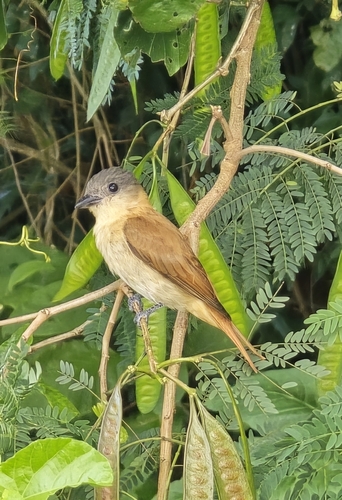
Crested Becard
Pachyramphus validus
The crested becard is 17 to 18.5 cm (6.7 to 7.3 in) long. The species is sexually dimorphic. Though its crown is somewhat shaggy it does not have an obvious raised crest. Adult males of the nominate subspecies have a mostly dark grayish to almost black crown, upperparts, wings, and tail with a partially hidden white patch on the back and some white on the scapulars. They have a smoky gray spot above the lores on an otherwise grayish face. Their throat is whitish gray and their underparts pale smoky grayish with a cinnamon tinge. Voice: The crested becard is not highly vocal. It sometimes makes an "unstructured series of extr./very high, sharp rolling and strident see notes". Its song has also been described as "a low, clear, vibrating, descending series of 6–8 dui whistles" and its call "a shrill tsree whistle".
ID text from Wikipedia, CC BY-SA 4.0
Where you might meet both
Learn this pair in the BeakBrain App
Photo and call practice. Coming soon to iPhone and Android.
Play today's Daily BirdPhotos and recordings are credited to their authors under the licence shown. Full profiles: Chestnut-crowned Becard and Crested Becard.