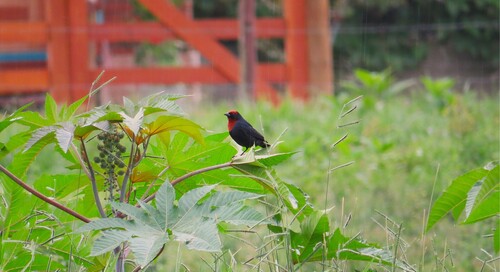
Chestnut-capped Blackbird
Chrysomus ruficapillus
Male chestnut-capped blackbirds average 18.5 cm (7.3 in) long and females 17.1 cm (6.7 in). Males weigh an average of 41.3 g (1.5 oz) and females average 32.2 g (1.1 oz). The species is sexually dimorphic. Adult males of the nominate subspecies have a deep dark chestnut forecrown, midcrown, throat, and upper breast. The rest of their plumages is black with a faint bluish gloss. Adult females of the nominate subspecies have a mostly olivaceous brown head with a faint buffish supercilium. Their upperparts are also olivaceous brown with faint dusky streaks. Voice: Male chestnut-capped blackbirds sing two types of songs, though they are highly variable among individuals even within a colony. One type "starts with clicks, warbles or whistles and ends in descending nasal buzz". The other type is "quite musical, either a series of loud, short and tremulous whistles around a sustained pitch...or flute-like notes on ascending scale".
ID text from Wikipedia, CC BY-SA 4.0
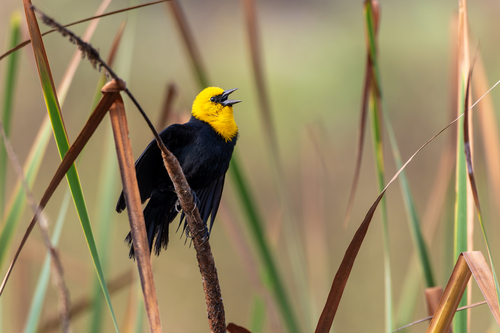
Yellow-hooded Blackbird
Chrysomus icterocephalus
The yellow-hooded blackbird is about 17 to 19 cm (6.7 to 7.5 in) long. Males weigh an average of 35.9 g (1.3 oz) and females average 26.8 g (0.95 oz). The species is sexually dimorphic. Adult males of the nominate subspecies have a bright yellow head, throat, neck, and upper breast except for black lores. Ther rest of their plumage is glossy black. Adult females of the nominate subspecies have a yellow supercilium, throat, and upper breast. Their crown and the rest of their face are citrine. Their upperparts are dull grayish olive with dusky streaks. Voice: Male yellow-hooded blackbirds sing two types of songs. One is "brief notes or whistles followed by harsh buzz" and the other "a more variable and pleasant sequence of warbles or whistles". Groups often sing together. The species' calls are chek and "a descending whistle".
ID text from Wikipedia, CC BY-SA 4.0
Where you might meet both
Learn this pair in the BeakBrain App
Photo and call practice. Coming soon to iPhone and Android.
Play today's Daily BirdPhotos and recordings are credited to their authors under the licence shown. Full profiles: Chestnut-capped Blackbird and Yellow-hooded Blackbird.