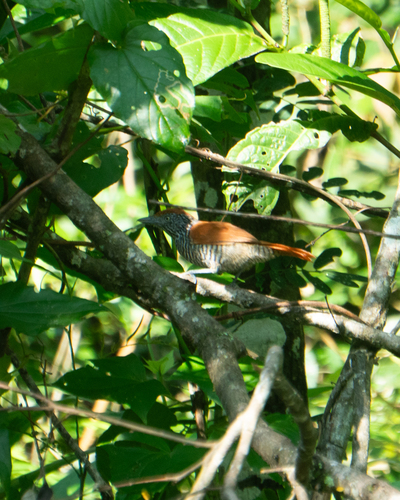
Chestnut-backed Antshrike
Thamnophilus palliatus
The lined antshrike is 16 to 17 cm (6.3 to 6.7 in) long and weighs 26 to 28 g (0.92 to 0.99 oz). Members of genus Thamnophilus are largish members of the antbird family; all have stout bills with a hook like those of true shrikes. This species exhibits some sexual dimorphism though both sexes have a crest. Adult males of the nominate subspecies T. p. palliatus have a black crown with white spots on the forehead. Their face and nape are black with white spots. Their upperparts, wings, and tail are rufous-brown. Voice: The chestnut-backed antshrike's song is "a moderately long...accelerating series of similar, rapidly delivered, somewhat nasal notes, pitch rising slightly initially, more clearly falling towards end, terminating in longer, firmly accented, downslurred note". It has been written as kah kah-kah-kah-ka'ka'ka'kaka'pah".
ID text from Wikipedia, CC BY-SA 4.0
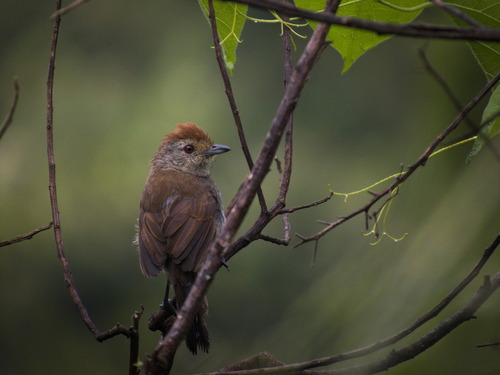
Rufous-capped Antshrike
Thamnophilus ruficapillus
The rufous-capped antshrike is 15 to 17 cm (5.9 to 6.7 in) long and weighs 16.3 to 25 g (0.57 to 0.88 oz). Members of genus Thamnophilus are largish members of the antbird family; all have stout bills with a hook like those of true shrikes. This species exhibits significant sexual dimorphism. Adult males of the nominate subspecies T. r. ruficapillus have a chestnut crown and a buffy gray face and throat with faint dusky mottling and bars. Their upperparts are dark brown. Their wings are rufous-brown. Their tail is brownish black with white tips and bars on the inner webs of the outer feathers. Voice: The rufous-capped antshrike's song apparently has some regional variations that have not been studied. It has been described as a "slightly accelerating series of 12-15 'tjew' notes". It has been written as "wah, nyah, nyah-nyah-nya-nya-nya'nya-arr" and as "weepweepweepweepweepweepeepeepeep".
ID text from Wikipedia, CC BY-SA 4.0
Where you might meet both
Learn this pair in the BeakBrain App
Photo and call practice. Coming soon to iPhone and Android.
Play today's Daily BirdPhotos and recordings are credited to their authors under the licence shown. Full profiles: Chestnut-backed Antshrike and Rufous-capped Antshrike.