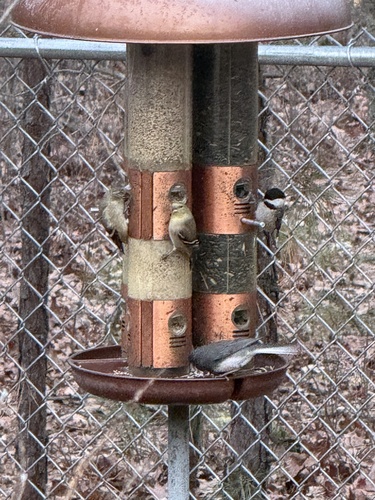
Carolina Chickadee
Poecile carolinensis
Adults are 11.5–13 cm (4.5–5.1 in) long with a weight of 9–12 g (0.32–0.42 oz), and have a black cap and bib with white sides to the face. Their underparts are white with rusty brown on the flanks; their back is gray. They have a short dark bill, short wings and a moderately long tail. Very similar to the black-capped chickadee, the Carolina chickadee is distinguished by the slightly browner wing with the greater coverts brown (not whitish fringed) and the white fringing on the secondary feathers slightly less conspicuous; the tail is also slightly shorter and more square-ended. Voice: The calls and song between the Carolina chickadee and the black-capped chickadee differ subtly to an experienced ear: the Carolina chickadee's chick-a-dee call is faster and higher pitched than that of the black-capped chickadee, and the Carolina chickadee has a four note fee-bee-fee-bay song, whereas the black-capped omits the high notes.
ID text from Wikipedia, CC BY-SA 4.0

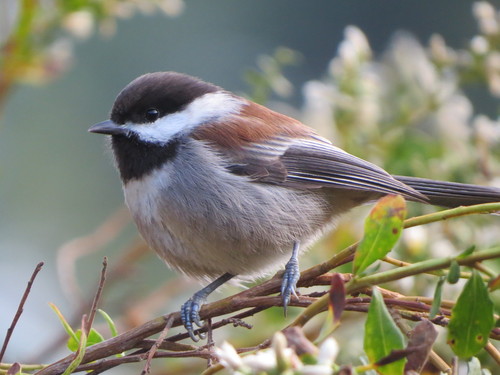
Chestnut-backed Chickadee
Poecile rufescens
It is a small chickadee, 11.5–12.5 cm (4.5–4.9 in) long with a weight of 8.5–12.6 g (0.30–0.44 oz). The head is dark blackish-brown with white cheeks, the mantle is bright rufous-brown, the wing feathers are dark gray with paler fringes. The underparts are white to pale grayish-white, with rufous or pale gray flanks. It is often considered the most vibrant of all chickadees. Joseph Grinnell was one of the first to provide a significantly detailed description of this variation. Voice: Chestnut-backed chickadees can be identified by their “chick-a-dee” call, with “dee” repeated a few times. Adults and older nestlings can also be identified by their hissing noise, which mimics a snake while protecting their nests. They rarely use their “gargle” calls.
ID text from Wikipedia, CC BY-SA 4.0

Where you might meet both
Learn this pair in the BeakBrain App
Photo and call practice. Coming soon to iPhone and Android.
Play today's Daily BirdPhotos and recordings are credited to their authors under the licence shown. Full profiles: Carolina Chickadee and Chestnut-backed Chickadee.