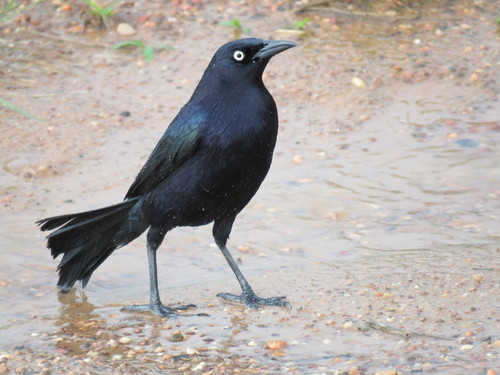
Carib Grackle
Quiscalus lugubris
Male Carib grackles average 26 cm (10 in) long and females about 22 cm (8.7 in). Males weigh 66 to 80 g (2.3 to 2.8 oz) and females 49 to 58 g (1.7 to 2.0 oz). Males of all subspecies have a long keel-shaped ("V") tail; females' tails are shorter and flat. Adult males of the nominate subspecies Q. l. lugubris are completely black with a violet gloss on most of the body; it is slightly less strong on the underparts. The gloss is more violet-blue on the wing coverts and greener on the flight feathers. Voice: The Carib grackle's song varies among the subspecies but is "generally a series of squeaky notes". In the Antilles its vocalization is generally "3-7 syllables with rising inflection" and also "whistles and chucks". On Martinique it makes "a descending, Molothrus-like whistle followed by a complex warble" and on Trinidad "a series of rhythmic rattles ending in metallic sound".
ID text from Wikipedia, CC BY-SA 4.0

Greater Antillean Grackle
Quiscalus niger
The Greater Antillean grackle is 25 to 30 cm (9.8 to 12 in) long. Males weigh about 67 to 100 g (2.4 to 3.5 oz) except those of Q. n. crassirostris which average 112 g (4.0 oz). Females weigh about 50 to 72 g (1.8 to 2.5 oz) except those of Q. n. crassirostris which average 79 g (2.8 oz). Males have a long graduated tail which it holds in a "V" shape; females' tails are shorter and held flat. Adults of both sexes of all subspecies are entirely black; males are glossy and most females are less so. The nominate subspecies Q. n. niger is the smallest. Voice: The Greater Antillean grackle's song varies greatly among the subspecies "but (for a grackle) is relatively musical". Songs have been described as "a metallic cling-cling-cling and flute-like whistles". Its calls include "chuk or chuk-chuk or chin-chin-chilin high wee-si-si and harsh notes".
ID text from Wikipedia, CC BY-SA 4.0
Learn this pair in the BeakBrain App
Photo and call practice. Coming soon to iPhone and Android.
Play today's Daily BirdPhotos and recordings are credited to their authors under the licence shown. Full profiles: Carib Grackle and Greater Antillean Grackle.