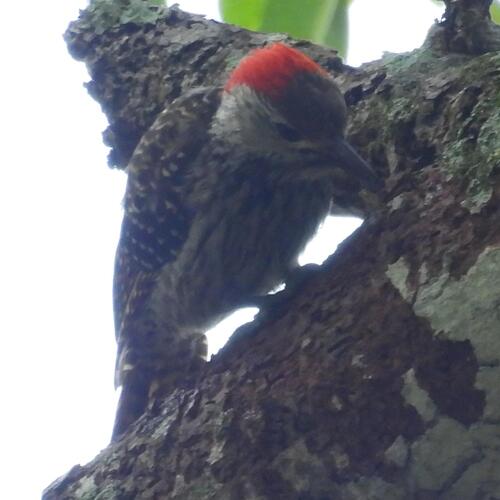
Cardinal Woodpecker
Dendropicos fuscescens
Like other woodpeckers, this species has a straight pointed bill, a stiff tail to provide support against tree trunks, and zygodactyl or "yoked" feet, with two toes pointing forward, and two backward. The long tongue can be darted forward to capture insects. This is a very small woodpecker. It measures 14 to 15 cm (5.5 to 5.9 in) from bill tip to tail tip, and its body shape is typical of a woodpecker. Its back plumage is dull olive in colour, and is marked with paler dots and bands. The underparts are white, heavily streaked with black, and the rump plumage is tawny.
ID text from Wikipedia, CC BY-SA 4.0

Olive Woodpecker
Dendropicos griseocephalus
The olive woodpecker is mostly plain, and lacks many of the patterns typically observed in other woodpecker species. It is characterized by a bright scarlet rump and upper-tail coverts, better revealed in flight. These scarlet feathers often have grey bases, and black subterminal bars. It has a darkish grey forecrown, hindneck, chin and neck, sometimes with black markings on its forehead. The olive woodpecker's belly is dark grey and olive coloured, with lighter golden tones on the breast. It displays a red or pink belly-patch which can vary in size. Voice: The olive woodpecker is known to give many different vocalizations. This woodpecker produces a short, nasally 3 to 4 note whistle "whee-whee-whee" . It is also known to emit a mocking or quivering "yeh-yeh-yeh-yeh". Sometimes, the olive woodpecker can also produce a squeaky "tweet-tweet-tweet". Within groups, these woodpeckers conversate with "pep" or "pep-pep-pep" notes.
ID text from Wikipedia, CC BY-SA 4.0
Where you might meet both
Learn this pair in the BeakBrain App
Photo and call practice. Coming soon to iPhone and Android.
Play today's Daily BirdPhotos and recordings are credited to their authors under the licence shown. Full profiles: Cardinal Woodpecker and Olive Woodpecker.