
Canyon Wren
Catherpes mexicanus
The canyon wren measures 14–15 cm (5.5–5.9 in) with a long thin beak and square-tipped tail. Its speckled, chestnut coloration shades to gray at the head with a contrasting white throat patch. Its coloration and small size allow it to camouflage seamlessly with its rocky environment. The canyon wren's loud, distinctive call consists of a series of cascading notes. It sings most frequently in spring, however mated pairs may sing at any time. When defending its territory, the song is harsher and has a lower frequency,
ID text from Wikipedia, CC BY-SA 4.0

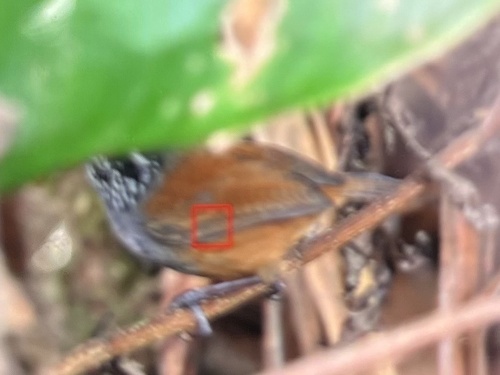
Grey-breasted Wood Wren
Henicorhina leucophrys
The nominate subspecies of grey-breasted wood wren is 10 to 11.5 cm (3.9 to 4.5 in) long and weighs 13.5 to 17.7 g (0.48 to 0.62 oz). Its crown feathers are dull black with dark brown tips. Its nape and shoulders are a dark olive brown and its lower back, rump, and tail chestnut brown. The tail has blackish bars. It has a long gray-white supercilium, a wide black stripe behind the eye, and black cheeks streaked with pale gray. Its chin and throat are pale gray, the chest and belly a darker gray, and the sides of the belly and the lower flanks a dark buff. Voice: The songs and calls of the grey-breasted wood wren vary considerably across its range. In general the songs are "a series of very loud, ringing, energetic musical phrases, frequently repeated". It sings "virtually year-round and throughout the day, in all types of weather" and is "far more commonly heard than seen."
ID text from Wikipedia, CC BY-SA 4.0

Where you might meet both
Learn this pair in the BeakBrain App
Photo and call practice. Coming soon to iPhone and Android.
Play today's Daily BirdPhotos and recordings are credited to their authors under the licence shown. Full profiles: Canyon Wren and Grey-breasted Wood Wren.