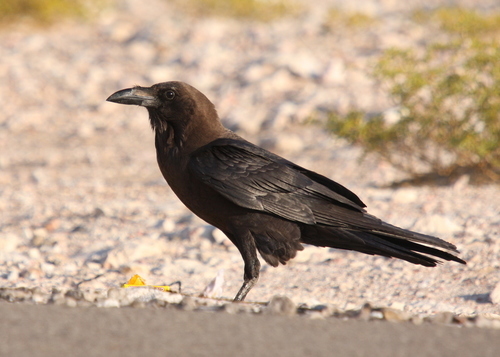
Brown-necked Raven
Corvus ruficollis
Voice: The voice is very similar to the common raven's consisting mainly of croaks, though higher in pitch; and a harsh "karr-karr-karr". In flight, it will utter a "kuerk-kuerk" call. Like all corvids, the Brown-necked raven is capable of vocal mimicry, however this behavior is mostly recorded in captivity and, although rarely, in the wild.
ID text from Wikipedia, CC BY-SA 4.0
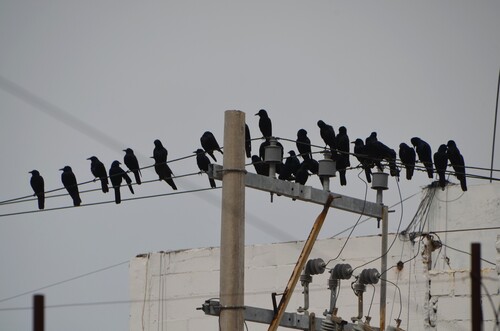
Sinaloa Crow
Corvus sinaloae
The Sinaloa crow is 35.5 to 38 cm (14 to 15 in) long; two individuals weighed 229 and 258 g (8.1 and 9.1 oz). The sexes have the same plumage, which is nearly identical to that of the Tamaulipas crow. Adults have glossy dark violet crown, nape, secondary wing coverts, and secondaries. The sides of their neck and their back, scapulars, rump, uppertail coverts, and primary coverts are glossy dark violet blue. Their primaries and rectrices are dark steel blue with a greenish tinge on the outer primaries and a violet tinge on the central rectrices. Voice: The Sinaloa crow's voice is the characteristic that led to its recognition as a species separate from the Tamaulipas crow. The Tamaulipas crow's voice is burry or croaking, characters absent from that of the Sinaloa crow.
ID text from Wikipedia, CC BY-SA 4.0

Learn this pair in the BeakBrain App
Photo and call practice. Coming soon to iPhone and Android.
Play today's Daily BirdPhotos and recordings are credited to their authors under the licence shown. Full profiles: Brown-necked Raven and Sinaloa Crow.