
Brown-hooded Gull
Chroicocephalus maculipennis
Adults in the breeding season have a dark brown head and throat with a white semicircle around the posterior of the eye, while the neck, chest and abdomen are white. In winter plumage, the brown hood is largely lost, retaining just a dark spot behind the eye and a dark smudge around the eye. The beak and legs are red, and the eye is dark brown. The outer primary flight feathers are white with black tips (the 'spots' of the scientific name) above and showing more extensively black from below, while the inner primaries and the secondaries and covert feathers are a silvery grey.
ID text from Wikipedia, CC BY-SA 4.0
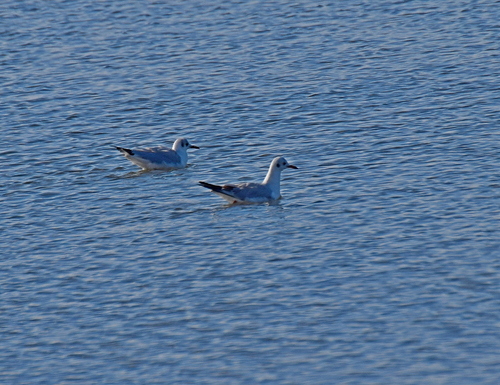
Slender-billed Gull
Chroicocephalus genei
This species is 37 to 40 cm (14.6 to 15.7 in) long with a 90 to 102 cm (35.4 to 40.2 in) wingspan. It is therefore slightly larger than the black-headed gull, which it resembles, although it does not have a black hood in summer. It has a pale grey body, white head and breast and black tips to the primary wing feathers. The head and dark red bill have an elongated tapering appearance, and this bird also appears long-necked. The legs are dark red, and the iris is yellow. In summer, the breast has a faint pink colouration. This bird takes two years to reach maturity, as is usual in gulls.
ID text from Wikipedia, CC BY-SA 4.0
Learn this pair in the BeakBrain App
Photo and call practice. Coming soon to iPhone and Android.
Play today's Daily BirdPhotos and recordings are credited to their authors under the licence shown. Full profiles: Brown-hooded Gull and Slender-billed Gull.