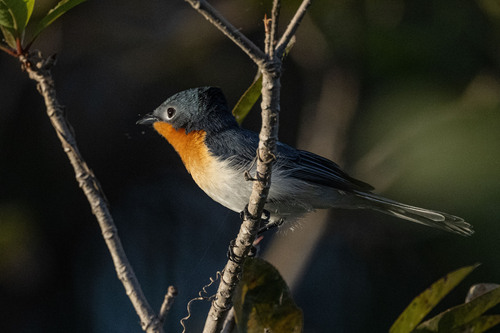
Broad-billed Flycatcher
Myiagra ruficollis
In northern Australia, the broad-billed flycatcher is commonly found in moist forests and scrub surrounding permanent and seasonal fresh water areas such as billabongs and wet season marshes. Its size ranges from 14 to 17 cm. The bird feeds in the forest canopy on insects and small invertebrates. Unlike co-resident related species such as the paperbark flycatcher (M. nana) the broad-billed flycatcher is rarely seen hawking for insects in open areas outside the canopy.
ID text from Wikipedia, CC BY-SA 4.0
Satin Flycatcher
Myiagra cyanoleuca
The satin flycatcher is a small bird, around 17 cm tall, and weighing around 17g. They have a small, sharp, pointed beak used for catching small invertebrates (insects). The species has sexually dimorphic characteristics; the male birds are a glossy black-blue colour, with a white belly and small crest upon their head, while the females are a dusty brown-grey colour with a bright orange chest and throat, and a white belly. They stand upright, and their tail feathers spread out to form a 'fan' shape.
ID text from Wikipedia, CC BY-SA 4.0
Where you might meet both
Learn this pair in the BeakBrain App
Photo and call practice. Coming soon to iPhone and Android.
Play today's Daily BirdPhotos and recordings are credited to their authors under the licence shown. Full profiles: Broad-billed Flycatcher and Satin Flycatcher.