
Blue-and-white Mockingbird
Melanotis hypoleucus
The blue-and-white mockingbird is 24.2 to 28 cm (9.5 to 11.0 in) long; 20 specimens had a mean mass of 68 g (2.4 oz). The adults' upperparts are a dull slate blue that is slightly brighter on the crown. The wings and tail are slaty black. A conspicuous black "mask" covers from the lores past the eye. The underparts are white darkening to bluish or slate gray on the flanks and vent area. The juvenile has a similar pattern but its upperparts are dull slaty gray instead of blue. Voice: The blue-and-white mockingbird's song has been described as "an amazing medley of bird notes... a rapid series of monosyllables, now a shrill squeak, now a whistle, now a guttural croak...certainly not musical or harmonious". It also has a wide variety of calls.
ID text from Wikipedia, CC BY-SA 4.0
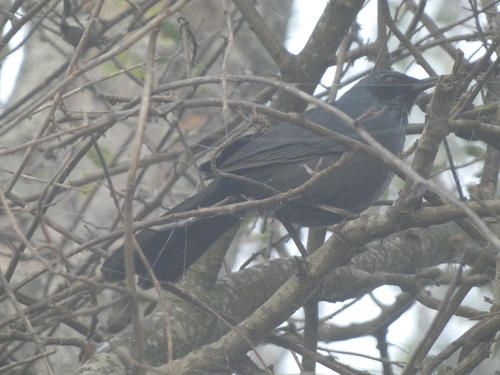
Blue Mockingbird
Melanotis caerulescens
Measuring 9.5–10.5 in (24–27 cm) in length, and weighing between 50.2 and 59.7 g (1.77 and 2.11 oz), the blue mockingbird is a medium-sized mimid. Individuals of the subspecies caerulescens have a mean body mass slightly higher than that for individuals of the subspecies longirostris — 63.5 g (2.24 oz) for the former and 59.7 g (2.11 oz) for the latter.
ID text from Wikipedia, CC BY-SA 4.0
Where you might meet both
Learn this pair in the BeakBrain App
Photo and call practice. Coming soon to iPhone and Android.
Play today's Daily BirdPhotos and recordings are credited to their authors under the licence shown. Full profiles: Blue-and-white Mockingbird and Blue Mockingbird.