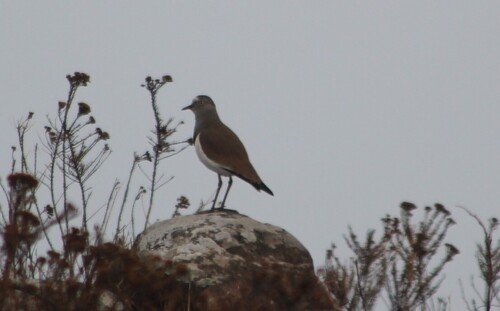
Black-winged Lapwing
Vanellus melanopterus
A black breast band separates the lapwing's grey head and neck from the white underside. The wing coverts are brown. It has a variable but prominent white forehead patch similar to its near relative, the Senegal lapwing, but in contrast shows a prominent white wingbar in flight, bordered by black remiges. The two species are also separated by their respective habitat preferences, the Senegal lapwing preferring lower, mostly drier locations.
ID text from Wikipedia, CC BY-SA 4.0

Long-toed Lapwing
Vanellus crassirostris
The long-toed lapwing measures 31 cm (12 in) in length with a body mass of 162–225 g (5.7–7.9 oz). It is a brown, black, and white lapwing with long red legs, long toes, and a red bill with a black tip. It has short wing spurs and rounded wings; in flight it shows extensive white in the wing feathers, as well as legs and feet extending beyond the end of the tail. It is sexually monomorphic and has no seasonal variation in plumage. Juveniles have a browner breast than adults and buff tips to feathers. Juvenile primary feathers are retained after the post-juvenile moult. Voice: Calls consist of repeated clicking with a metallic tone, described as "kick-k-k-k", and a high-pitched "wheet" call when flushed. Long-toed lapwings are more vocal during the breeding season, and they call rapidly as they attack other birds in their territories.
ID text from Wikipedia, CC BY-SA 4.0
Where you might meet both
Learn this pair in the BeakBrain App
Photo and call practice. Coming soon to iPhone and Android.
Play today's Daily BirdPhotos and recordings are credited to their authors under the licence shown. Full profiles: Black-winged Lapwing and Long-toed Lapwing.