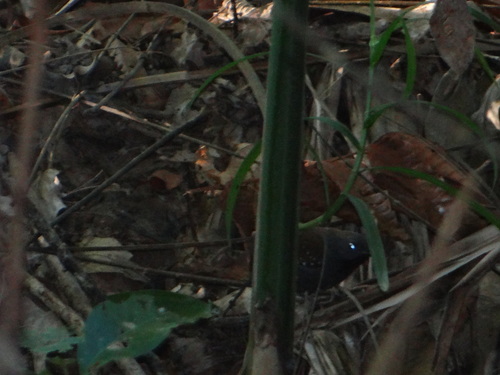
Black-throated Antbird
Myrmophylax atrothorax
The black-throated antbird is 13 to 14 cm (5.1 to 5.5 in) long and weighs 14 to 18 g (0.49 to 0.63 oz). Adult males of the nominate subspecies M. a. atrothorax have a gray face. Their crown and upperparts are dark yellowish olive-brown that becomes blackish on the rump, with a white patch between the shoulders. Their tail is blackish gray. Their wings are dark yellowish olive-brown with black and white tips on the coverts. The center of their throat and breast are black and the rest of their underparts gray. Voice: The black-throated antbird's song is a "very high, slightly decelerating series of 4-8 very sharp 'chee' notes, starting with a stuttered 'tutu', then slightly rising in strength and in pitch, together as 'tutu-chee-cheé- -' ". Its calls include a "sharply downslurred...note" and a "mixture of abrupt 'chit' notes given in short bursts mixed with moderately long...flat whistles".
ID text from Wikipedia, CC BY-SA 4.0


Jet Antbird
Cercomacra nigricans
The jet antbird is 14 to 15.5 cm (5.5 to 6.1 in) long and weighs 15 to 17.5 g (0.53 to 0.62 oz). Adult males are almost entirely black, with white edges on their outer scapulars, a white patch between them, and a hidden white patch under them. Their wing coverts and tail feathers have white tips and their flight feathers have white inner edges. Females are mostly blackish gray, with white in the same places as the male. They also have a whitish ring around the eye, thin white streaks on their throat and breast, and white barring on their lower belly. Voice: The male jet antbird's song is "4 or more pairs of notes, each pair consisting of sharp abrupt note followed by longer burry note" and has been written as "harsh paired 'tch-ker' notes". The species' call is "a harsh note repeated in series" like "chak chak chak chak chak chak".
ID text from Wikipedia, CC BY-SA 4.0
Where you might meet both
Learn this pair in the BeakBrain App
Photo and call practice. Coming soon to iPhone and Android.
Play today's Daily BirdPhotos and recordings are credited to their authors under the licence shown. Full profiles: Black-throated Antbird and Jet Antbird.