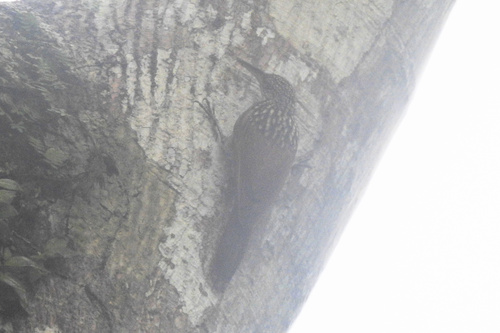
Black-striped Woodcreeper
Xiphorhynchus lachrymosus
The black-striped woodcreeper is 21.5 to 25 cm (8.5 to 9.8 in) long and weighs 51 to 66 g (1.8 to 2.3 oz). It is a medium-sized member of genus Xiphorhynchus, with a longish, nearly straight, bill with a slight droop at the tip. The sexes have the same plumage. Adults of the nominate subspecies have a brownish black face with buff streaks and no distinct supercilium. Their crown and nape are brownish black with buffy teardrop spots and wide streaks. Their back and scapulars are also brownish black with wider and deeper buff streaks. Voice: The black-striped woodcreeper's song is "a soft, descending whinny...clear whistles that begin slowly, speed up, then slow at end, 'wi, di, di, di, di-di-di-di-di-di, di, di, dew'.
ID text from Wikipedia, CC BY-SA 4.0


Spotted Woodcreeper
Xiphorhynchus erythropygius
The spotted woodcreeper is 19 to 24 cm (7.5 to 9.4 in) long. Males weigh 40 to 54 g (1.4 to 1.9 oz) and females 40 to 46 g (1.4 to 1.6 oz). It is a medium-sized member of genus Xiphorhynchus, with a longish, slightly decurved and gradually tapering bill. The sexes have the same plumage. Adults of the nominate subspecies X. e. erythropygius have dusky lores, a buff supercilium and eyering, and dusky olive ear coverts with buff streaks. Their crown and nape are dark olive to brownish olive with small buff spots and a narrow dusky edge. Voice: The spotted woodcreeper is rather vocal. It mostly sings at dawn and dusk and less frequently during the day. Its song is "a series 4–6·5 seconds long of 2–5 (usually 3–4) long descending whistles, each at progressively lower pitch, and sometimes followed by 1–2 additional notes at same pitch".
ID text from Wikipedia, CC BY-SA 4.0

Where you might meet both
Learn this pair in the BeakBrain App
Photo and call practice. Coming soon to iPhone and Android.
Play today's Daily BirdPhotos and recordings are credited to their authors under the licence shown. Full profiles: Black-striped Woodcreeper and Spotted Woodcreeper.