
Black-faced Antbird
Myrmoborus myotherinus
The black-faced antbird is 12 to 13.5 cm (4.7 to 5.3 in) long and weighs 16 to 22 g (0.56 to 0.78 oz). Adult males of the nominate subspecies M. m. myotherinus have a dark bluish gray crown, nape, and upperparts with a small white patch between their scapulars. Their wings and tail are slightly darker gray with white tips on the wing coverts. Their face is mostly black with a pale supercilium. Their throat is black and the rest of their underparts pale gray with slightly darker sides, flanks, and crissum. Adult females have a dark grayish olive-brown crown, nape, and upperparts. Voice: The song of the nominate black-faced antbird is "a countable series...of evenly spaced, somewhat unclear (frequency-modulated) notes, pitch and intensity rising initially, falling terminally, notes become longer throughout" that has been written as "zree-zree-zree-zrut-zrut".
ID text from Wikipedia, CC BY-SA 4.0

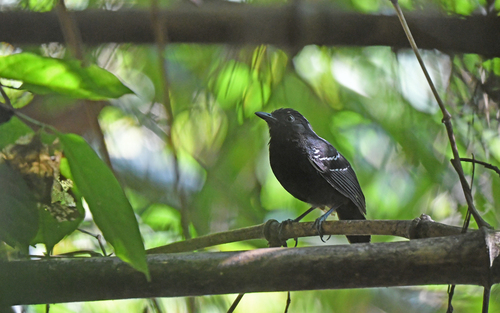
White-lined Antbird
Myrmoborus lophotes
The white-lined antbird is 14 to 14.5 cm (5.5 to 5.7 in) long and weighs 28 to 31 g (0.99 to 1.1 oz). Both sexes have a prominent crest. Adult males are mostly blackish gray, with their head and breast being the darkest and their flanks the lightest shades. They have a white patch between their scapulars. Their outermost primaries have a narrow white edge and their wing coverts have white tips. Adult females have a cinnamon-rufous crown. Their upperparts, wings, and tail are reddish yellow-brown with cinnamon-rufous edges on the wing coverts. Their face is grayish. Voice: The white-lined antbird's song is "a descending, accelerating series of hollow whistles, with a noticeably long space between the first note and the rest of the song: TEW tew-tew-tew'tew'tew'tu'tutu". Its call is "a hollow, musical chew note" that is often followed by "a growled reeh".
ID text from Wikipedia, CC BY-SA 4.0
Where you might meet both
Learn this pair in the BeakBrain App
Photo and call practice. Coming soon to iPhone and Android.
Play today's Daily BirdPhotos and recordings are credited to their authors under the licence shown. Full profiles: Black-faced Antbird and White-lined Antbird.