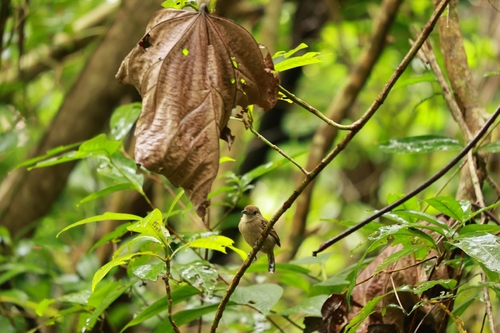
Black-crowned Antshrike
Thamnophilus atrinucha
The black-crowned antshrike is 14 to 15 cm (5.5 to 5.9 in) long and weighs 20 to 28.5 g (0.71 to 1.0 oz). Members of genus Thamnophilus are largish members of the antbird family; all have stout bills with a hook like those of true shrikes. This species exhibits significant sexual dimorphism. Adult males of the nominate subspecies have slaty gray upperparts with a gray forehead, a black crown and nape, a hidden white patch between their scapulars, and white-tipped black uppertail coverts. Their face is grizzled gray. Voice: The black-crowned antshrike's most common song is "a series of uh notes ending with a single erk at a higher pitch". Both sexes sing, commonly in the morning but at any time of day. The song has been written as "wur wur wur-wur-wur-wur'wur'wur'wur; AH" and "anhanhanhanhanhanhanhanhanhánh". Its calls include "a 1–4-note (usually 2) caw arr-arr and a bark-rattle: arr-grr'r'r'r".
ID text from Wikipedia, CC BY-SA 4.0


Black-hooded Antshrike
Thamnophilus bridgesi
The black-hooded antshrike is 15 to 17 cm (5.9 to 6.7 in) long and weighs 26 to 27 g (0.92 to 0.95 oz). Members of genus Thamnophilus are largish members of the antbird family; all have stout bills with a hook like those of true shrikes. This species exhibits some sexual dimorphism. Adult males are mostly black. They have a white patch between their scapulars, small white dots on their wing coverts, and dark gray belly and undertail coverts. Adult females have blackish gray forehead, crown, and face with narrow white streaks. Voice: Garrigues and Dean describe the black-hooded antshrike's song as "an accelerating series of staccato notes that end in a longer, lower note". VanPerlo describes it as a "high wooden wekwekwekkerwikkerwek, varied in speed and length". Its call is "an extended, complaining note, usually repeated 2–3 times".
ID text from Wikipedia, CC BY-SA 4.0
Where you might meet both
Learn this pair in the BeakBrain App
Photo and call practice. Coming soon to iPhone and Android.
Play today's Daily BirdPhotos and recordings are credited to their authors under the licence shown. Full profiles: Black-crowned Antshrike and Black-hooded Antshrike.