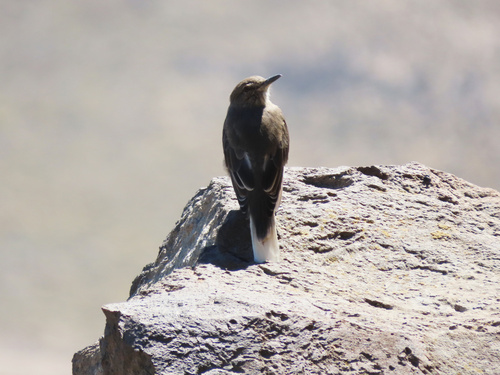
Black-billed Shrike-Tyrant
Agriornis montanus
The black-billed shrike-tyrant is 22 to 24 cm (8.7 to 9.4 in) long. The sexes have the same plumage. Adults of the nominate subspecies A. m. montanus have a whitish stripe above the lores, a buffish white broken supercilium, and brown-streaked white cheeks. Their crown and upperparts are dark grayish brown. Their wings are mostly dark grayish brown with whitish tips and edges on the inner flight feathers. Their underwing coverts are cinnamon-buff to buffy white. Their central pair of tail feathers is blackish; the rest are white with dark bases on their inner webs. Voice: The black-billed shrike-tyrant is not highly vocal but sings more frequently at dawn than during the day. Its voice has been described as "a loud, ringing wheee, wheeeu or just sheeeu." Another description calls its song "a loud, musical, whistled, rising-falling WEEYOO" and its call "a rising wee?".
ID text from Wikipedia, CC BY-SA 4.0


Great Shrike-Tyrant
Agriornis lividus
The great shrike-tyrant is the largest species of tyrant flycatcher, weighing an average of about 99 g (3.5 oz). It is 26 to 28 cm (10 to 11 in) long. The sexes have the same plumage. Adults of the nominate subspecies have a mostly grayish brown head with some whitish on the lores and a cinnamon tinge on the ear coverts. Their upperparts are grayish brown. Their wings are mostly a duskier grayish brown with pale brown edges on the flight feathers. Their tail is mostly black with buffy white tips and edges of the outer webs of the outer feathers. Their throat is white with heavy black streaks. Voice: The great shrike-tyrant is usually quiet. It does make "t-eek or t-eek-ek" calls.
ID text from Wikipedia, CC BY-SA 4.0
Where you might meet both
Learn this pair in the BeakBrain App
Photo and call practice. Coming soon to iPhone and Android.
Play today's Daily BirdPhotos and recordings are credited to their authors under the licence shown. Full profiles: Black-billed Shrike-Tyrant and Great Shrike-Tyrant.