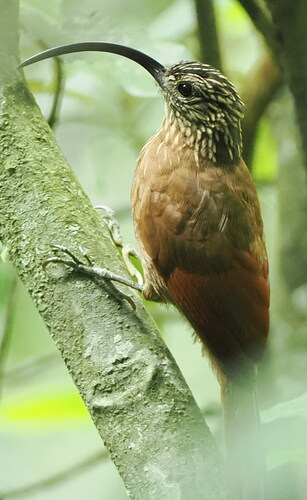
Black-billed Scythebill
Campylorhamphus falcularius
The black-billed scythebill is 24 to 28 cm (9.4 to 11 in) long and weighs 37 to 42 g (1.3 to 1.5 oz). It is a slim, medium-sized woodcreeper with a very long, slim, dramatically decurved bill. The sexes have the same plumage. Adults have a thinly streaked face of buff and blackish with a narrow buffy-white supercilium. Their neck has the same colored streaks but they are coarser. Their crown and nape are blackish, with thin whitish to ochre streaks that extend onto the upper back. Their back, wing coverts, and rump are brownish to olive-brown. Voice: The black-billed scythebill's song is a "level or descending, raspy 'sree-sree-sree- -' " repeated five or six times. Its call is a "very high, piercing 'pjeetpjeet'."
ID text from Wikipedia, CC BY-SA 4.0
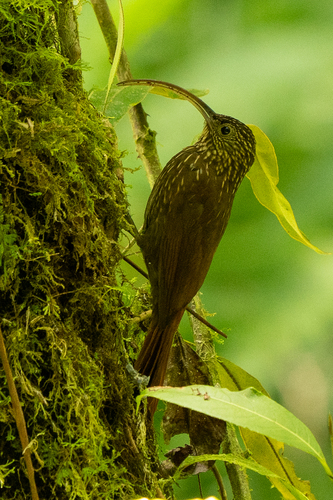
Brown-billed Scythebill
Campylorhamphus pusillus
The brown-billed scythebill is 20 to 25 cm (7.9 to 9.8 in) long and weighs 32 to 48 g (1.1 to 1.7 oz). It is a slim, medium-sized woodcreeper with a very long, slim, dramatically decurved bill. The sexes have the same plumage. Adults of the nominate subspecies have a face and neck streaked buff and blackish brown, with a faint buffy supercilium. Their crown and nape are dark brown, with thin deep buff streaks that extend sparsely onto the upper back. Their back and wing coverts are deep reddish brown, their rump is cinnamon-rufous, and their wings and tail are rufous-chestnut. Voice: The brown-billed scythebill sings mostly at dawn and dusk. Its song is complex and highly variable, a "series of notes lasting 2·5–5 seconds, beginning with a soft, twittering trill that continues in background during a series of loud whistles that are usually descending (sometimes ascending) and somewhat quavering, e.g.
ID text from Wikipedia, CC BY-SA 4.0

Learn this pair in the BeakBrain App
Photo and call practice. Coming soon to iPhone and Android.
Play today's Daily BirdPhotos and recordings are credited to their authors under the licence shown. Full profiles: Black-billed Scythebill and Brown-billed Scythebill.