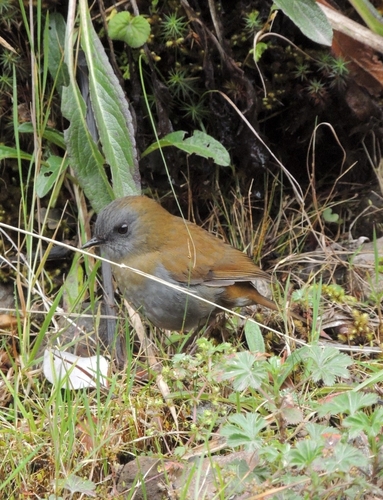
Black-billed Nightingale-Thrush
Catharus gracilirostris
The black-billed nightingale-thrush is about 15 cm (5.9 in) long and weighs about 20 g (0.71 oz) The sexes have the same plumage. Adults of the nominate subspecies have a slate-gray forecrown, an olive-brown crown, and a slate-gray face. Their upperparts, wings, and the upper side of their tail are olive-brown. Their throat is whitish, the middle of their lower belly light gray to whitish, and the rest of their underparts slate-gray with an olivaceous band across the breast. They have a dark brown iris, a black bill, and dark gray legs and feet. Voice: The black-billed nightingale-thrush has a variety of vocalizations. Its song is composed of up to about 18 phrases, each different than the preceding one, and typically alternating between higher and lower pitches. Males usually sing from within understory vegetation and only seldom much higher. During the breeding season males countersing.
ID text from Wikipedia, CC BY-SA 4.0
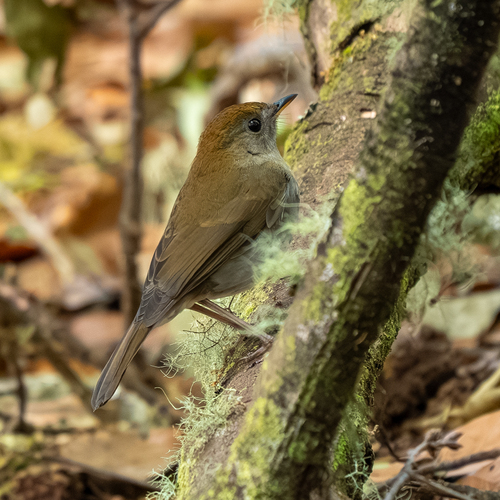
Ruddy-capped Nightingale-Thrush
Catharus frantzii
The ruddy-capped nightingale-thrush is about 15 to 18 cm (5.9 to 7.1 in) long and weighs about 30 g (1.1 oz). The sexes have the same plumage. Adults of the nominate subspecies C. f. frantzii have a rich rufous-brown to russet crown and a grayish face that sometimes has an olive tinge. Their back and rump are brownish olive with a russet wash and their uppertail coverts are deep rufous-brown. Their wings are mostly the same color as the back and rump but with silvery white undersides on the flight feathers. Their tail is deep rufous-brown. Their chin and throat are whitish with dark flecks. Voice: The ruddy-capped nightingale-thrush's song is "an ethereal, melancholic, liquid, and throaty, persistently uttered, and far-carrying series of short, deliberate and diverse phrases, with fluty trills, clear whistles and warbles". It is usually sung in the morning or evening and also in misty weather.
ID text from Wikipedia, CC BY-SA 4.0
Where you might meet both
Learn this pair in the BeakBrain App
Photo and call practice. Coming soon to iPhone and Android.
Play today's Daily BirdPhotos and recordings are credited to their authors under the licence shown. Full profiles: Black-billed Nightingale-Thrush and Ruddy-capped Nightingale-Thrush.