
Black-bellied Wren
Pheugopedius fasciatoventris
Male black-bellied wrens weigh 23.5 to 34.5 g (0.83 to 1.22 oz) and females 19.5 to 28.5 g (0.69 to 1.01 oz). Adults of all three subspecies have a rich chestnut back and tail; the latter has black bars. They have a white supercilium of varying size above a grayish face and are white on the chin, throat, and breast. All three have a black belly, but that of P. f. melanogaster is unmarked while those of the other two subspecies have thin white bars. Voice: Both sexes of the black-bellied wren have large song repertoires; one male was recorded with 38 different songs and a female with 19. Multiple examples are available at Xeno-canto and Cornell's Macaulay Library .
ID text from Wikipedia, CC BY-SA 4.0
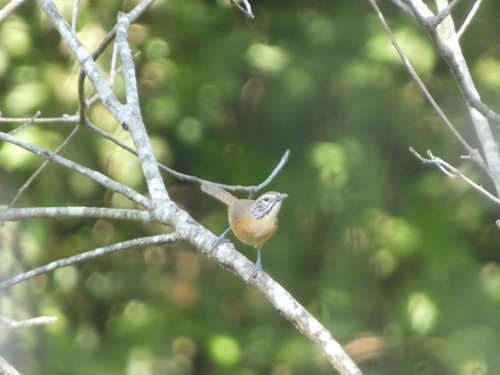
Happy Wren
Pheugopedius felix
There is little difference between the sexes as adults. They are fairly typical small wrens, with a black and white striped face, a downward curving bill, chestnut upperparts and cream underparts. Howell and Webb give its length as 12.5 – 14 cm. Voice: Like many wrens, happy wrens produce a complex song, described as a "rollicking, gurgling whistle." Songs are less varied among island populations. Pairs of happy wrens primarily use their duet songs for cooperative territory defense.
ID text from Wikipedia, CC BY-SA 4.0

Learn this pair in the BeakBrain App
Photo and call practice. Coming soon to iPhone and Android.
Play today's Daily BirdPhotos and recordings are credited to their authors under the licence shown. Full profiles: Black-bellied Wren and Happy Wren.