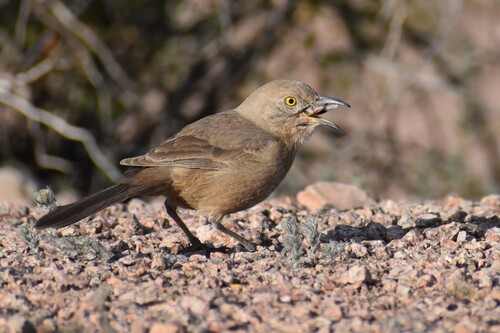
Bendire's Thrasher
Toxostoma bendirei
Because of its similar coloration and structure to the curve-billed thrasher, the two birds are very easy to mistake for one another. The Bendire's thrasher's shorter bill is a distinguishing feature when comparing mature birds, but it is still easy to misidentify an adult Bendire's thrasher as a young curve-billed thrasher as its beak has not grown to a mature length. The Bendire's thrasher's yellow eyes and pale-based lower mandible are additional markings which aid in separation from the curve-billed thrasher. Voice: Like other mimids, the often silent Bendire's thrasher incorporates the songs and calls of other species into its own songs. A sharp "chek" is the species' most common call.
ID text from Wikipedia, CC BY-SA 4.0

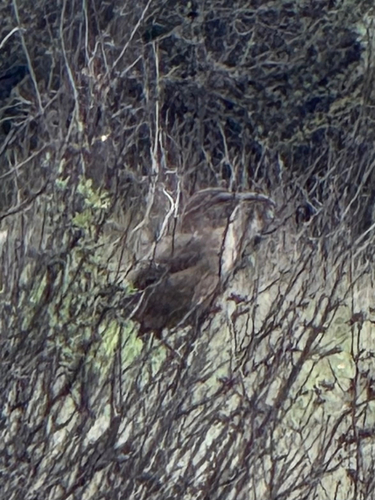
California Thrasher
Toxostoma redivivum
The California thrasher is about 32 cm (13 in) long and weighs up to 90 g (3.2 oz); it is the largest thrasher. It has a distinctive long, decurved beak and a long tail. It is generally deep grayish brown above with olive tones on the tail. It has a grayish buff supercilium, a dark cheek pattern and eye line, and unlike most thrashers, has dark eyes. The underparts are mostly buffy to tawny brown, with the upper breast and flanks a smoky gray. The two subspecies differ only slightly. Voice: The California thrasher is recognized as a "striking and exuberant songster" known for its mimicking capabilities. It imitates many of the species that share its habitat, a trait that has been documented as reflecting a rich vocal repertoire, showcasing a wide range of vocal imitations from other species.
ID text from Wikipedia, CC BY-SA 4.0

Where you might meet both
Learn this pair in the BeakBrain App
Photo and call practice. Coming soon to iPhone and Android.
Play today's Daily BirdPhotos and recordings are credited to their authors under the licence shown. Full profiles: Bendire's Thrasher and California Thrasher.