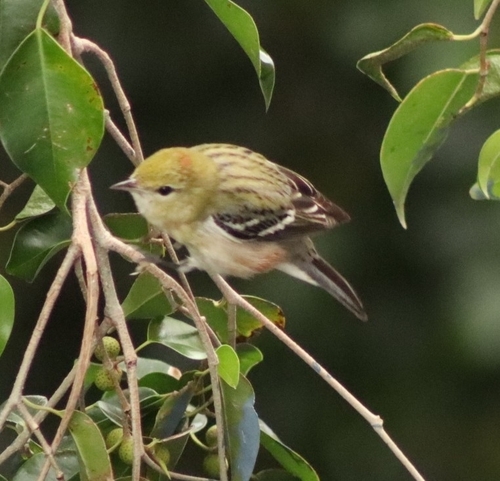
Bay-breasted Warbler
Setophaga castanea
Adult males in breeding plumage are primarily greyish above, with two white wing bars, dark streaks on the back, and a creamy neck patch. The face is black, and the crown, throat, and sides are a dark chestnut colour. Breeding females are similar in overall pattern to the males, but are paler and duller. In the nonbreeding season, both sexes gain olive-green feathers on the back, nape, and head. The rufous on the flanks is limited and may even fade away entirely in nonbreeding females. The two white wing bars are present in all plumages.
ID text from Wikipedia, CC BY-SA 4.0

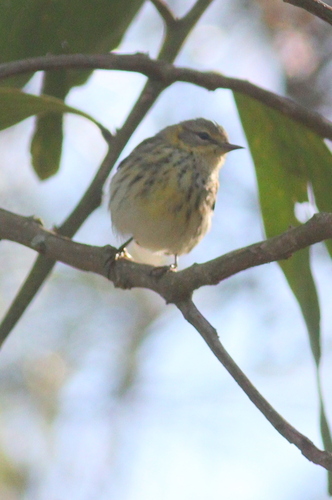
Cape May Warbler
Setophaga tigrina
This bird is a small passerine and is a mid-sized New World warbler. Length can vary from 12–14 cm (4.7–5.5 in), wingspan is 19–22 cm (7.5–8.7 in), and body mass can range from 9–17.3 g (0.32–0.61 oz). Among standard measurements, the wing chord is 6.1–7.3 cm (2.4–2.9 in), the tail is 4.3–5 cm (1.7–2.0 in), the bill is 0.9–1.2 cm (0.35–0.47 in) and the tarsus is 1.7–1.9 cm (0.67–0.75 in). The adult male Cape May warbler has a brown back, yellowish rump and dark brown crown. The underparts are yellow streaked with black, giving rise to the bird's scientific name.
ID text from Wikipedia, CC BY-SA 4.0

Where you might meet both
Learn this pair in the BeakBrain App
Photo and call practice. Coming soon to iPhone and Android.
Play today's Daily BirdPhotos and recordings are credited to their authors under the licence shown. Full profiles: Bay-breasted Warbler and Cape May Warbler.