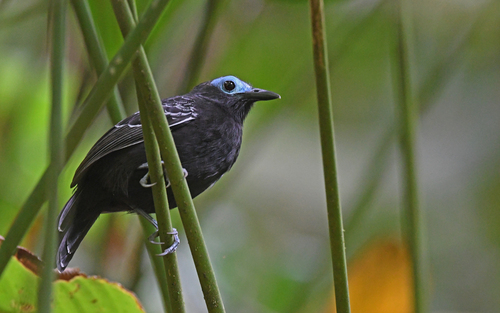
Bare-crowned Antbird
Gymnocichla nudiceps
The bare-crowned antbird is 15 to 17 cm (5.9 to 6.7 in) long and weighs 28 to 33 g (0.99 to 1.2 oz). Males of all four subspecies have bright blue bare skin on their forehead, forecrown, lores, and around their eyes. Females have the same blue skin on their lores and around their eyes. Adult males of the nominate subspecies G. n. nudiceps are otherwise almost entirely black. Their wing coverts have white tips, their alula and outermost primary have white edges, and their tail feathers have narrow white tips. Some individuals have a small white patch between their scapulars. Voice: The male bare-crowned antbird's song is "a series of clear sweet whistles, rising in middle and accelerating at end, Teuu-tip-Tip-Tip-Tip-Tip-Tip-Tip-Tip-Tip'Tip'Tip'Tip'Tip". Females sing a similar song starting in the middle of the male's song. One call is "a sharp Peeet!". Others are "a longer...rising and falling note...
ID text from Wikipedia, CC BY-SA 4.0
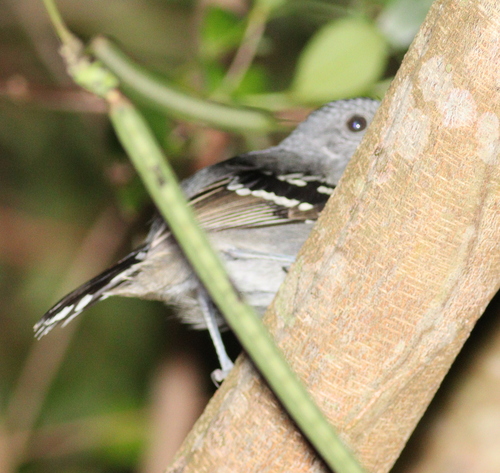
Northern Slaty Antshrike
Thamnophilus punctatus
The northern slaty antshrike is 13 to 15 cm (5.1 to 5.9 in) long and weighs 16 to 18 g (0.56 to 0.63 oz). Members of genus Thamnophilus are largish members of the antbird family; all have stout bills with a hook like those of true shrikes. This species exhibits significant sexual dimorphism. Adult males of the nominate subspecies T. p. punctatus have a gray forehead and a black crown. Their back is gray with a few black feather tips and a hidden white patch between their scapulars. Their face is gray. Their wings and wing coverts are black with white spots and edges. Voice: The northern slaty antshrike's song is "an accelerating series of usually 10–15 progressively shorter notes starting with laboured, slow-paced notes that are countable, ending with trill of abrupt uncountable notes often sounding higher in pitch". Its pace varies among the subspecies; that of T. p. leucogaster is the fastest.
ID text from Wikipedia, CC BY-SA 4.0
Where you might meet both
Learn this pair in the BeakBrain App
Photo and call practice. Coming soon to iPhone and Android.
Play today's Daily BirdPhotos and recordings are credited to their authors under the licence shown. Full profiles: Bare-crowned Antbird and Northern Slaty Antshrike.