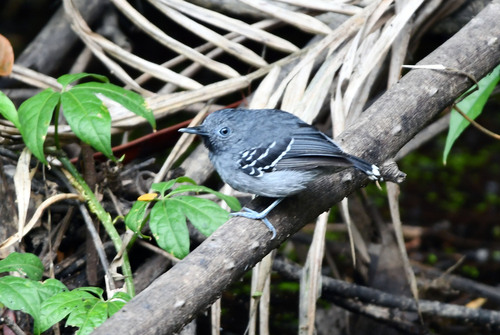
Band-tailed Antbird
Hypocnemoides maculicauda
The band-tailed antbird is about 12 cm (4.7 in) long and weighs 11.5 to 14.5 g (0.41 to 0.51 oz). Adult males have leaden gray upperparts with a large but usually hidden white patch between their scapulars. Their tail is slate gray with wide white feather tips. Their flight feathers are leaden gray with lighter gray edges and their wing coverts are black with gray and white edges. Their throat is black. Their underparts are mostly a paler gray than their upperparts and with a white belly. Adult females have the same leaden upperparts as males. Voice: One description of the band-tailed antbird's song is "an accelerating series of rising, modulated whistles followed by an abruptly decelerating series of rising burry note: hew hew-hu-hu'huHU' DJZE'DJZEE-djzwee djzww djzwee?". Another description is a "strong, accelerating series of loud raspy notes, rising in strength and pitch to a sharp rattle, then falling and decelerating".
ID text from Wikipedia, CC BY-SA 4.0
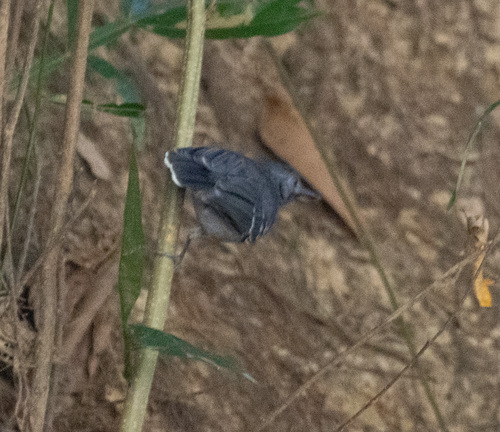
Black-chinned Antbird
Hypocnemoides melanopogon
The black-chinned antbird is 11 to 12.2 cm (4.3 to 4.8 in) long and weighs about 12 to 18 g (0.42 to 0.63 oz). Adult males have leaden gray upperparts. Their tail is slate gray with narrow white feather tips. Their flight feathers are leaden gray with lighter gray edges and their wing coverts are black with gray and white edges. Their throat is black. Their underparts are mostly a paler gray than their upperparts and with a grayish white belly. Adult females have the same leaden upperparts as males. Their throat is whitish with black and gray speckles. Voice: One description of the black-chinned antbird's song is "an accelerating, rising series of modulated, rising whistles that descends slightly at the end with much more buzzy notes: whee wee-wee'wee'wi'wi'wiwiwidz'dz'dzee". Another description is a "series of 8-12 high, accentuated 'few' notes, 1st 2-3 evenly-spaced and rising, then as 'djew' notes accelerating and bouncing down".
ID text from Wikipedia, CC BY-SA 4.0
Where you might meet both
Learn this pair in the BeakBrain App
Photo and call practice. Coming soon to iPhone and Android.
Play today's Daily BirdPhotos and recordings are credited to their authors under the licence shown. Full profiles: Band-tailed Antbird and Black-chinned Antbird.