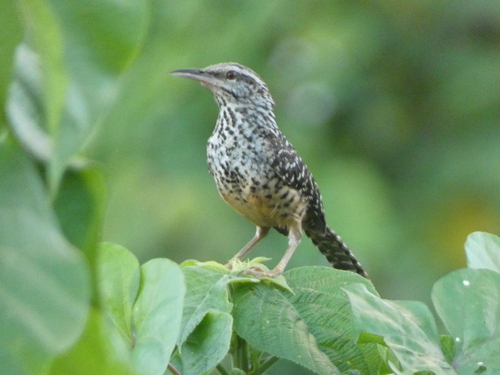
Band-backed Wren
Campylorhynchus zonatus
This large wren breeds in lowlands and foothills from sea level up to 1700 m altitude in thinned forest or open woodland, scrub, second growth and groves around houses. It mainly occurs on the Caribbean side of the Central American mountain ranges. Its large spherical nest has a wide side entrance and is constructed 2 – 30 m high in a tree or shrub, often hidden amidst bromeliads. The female alone incubates the three to five unmarked or lightly brown-spotted white eggs for about two weeks to hatching, and the young fledge in about the same length of time again.
ID text from Wikipedia, CC BY-SA 4.0

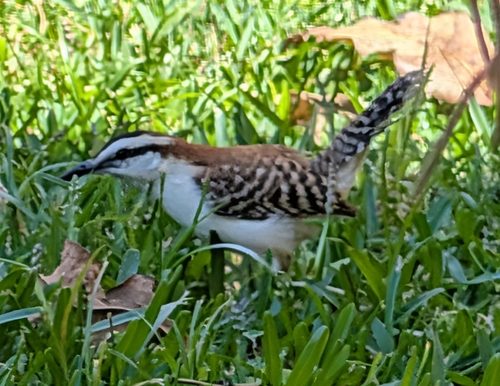
Rufous-backed Wren
Campylorhynchus capistratus
The adult rufous-backed wren is 17 cm (6.7 in) long and weighs 29 to 42 g (1.0 to 1.5 oz). There is some variation among the subspecies but generally they have a black crown and eyestripe separated by a white supercilium, a rufous nape, and cinnamon to chestnut upperparts streaked with black and white, especially on the rump. The wings and tail are barred with black and grayish-white. The underparts are white. Young birds have duller upperparts and buff underparts. Voice: The rufous-backed wren's songs vary somewhat among subspecies but the basic structure is "melodic, pure-tone syllables with multiple frequency changes combined into phrases." An example from Costa Rica is . One from Mexico is . Its calls have great variety even within each subspecies; examples include , , and .
ID text from Wikipedia, CC BY-SA 4.0
Where you might meet both
Learn this pair in the BeakBrain App
Photo and call practice. Coming soon to iPhone and Android.
Play today's Daily BirdPhotos and recordings are credited to their authors under the licence shown. Full profiles: Band-backed Wren and Rufous-backed Wren.