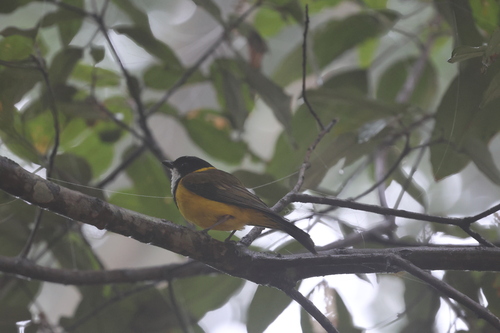
Australian Golden Whistler
Pachycephala pectoralis
The male has a bright yellow underside and nape, olive-green back and wings, a black head and chest-band, and a white throat. A notable exception is the Norfolk golden whistler (P. p. xanthoprocta) where the plumage of the male is female-like. In Australia females are overall dull brownish-grey, though some have yellowish undertail coverts. Both sexes have a black bill, dark legs and red-brown eyes. For subspecies P. p. contempta, the Lord Howe golden whistler, the male is similar to the male of the nominate race but has a duller yellow below which is slightly tinged with olive.
ID text from Wikipedia, CC BY-SA 4.0

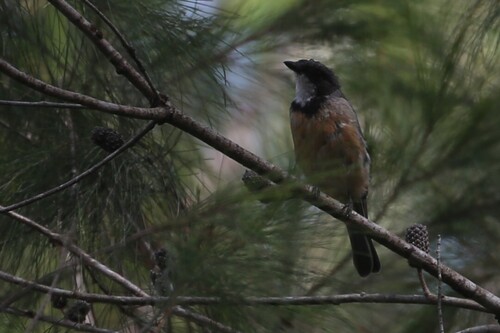
Rufous Whistler
Pachycephala rufiventris
Rufous whistlers are large-headed and stocky. They have short beaks and long tails (almost as long as the rest of the bird) which are very narrow and have sharp, forked tips. The species is sexually dimorphic. While females are typically dull brown or grey with streaked underbodies, males have rufous underparts and predominantly dark-grey back and tail with white throats and (in most cases) a black mask that covers most of their head and some of their neck. These birds are between 16 and 18 centimetres (6.3 and 7.
ID text from Wikipedia, CC BY-SA 4.0

Where you might meet both
Learn this pair in the BeakBrain App
Photo and call practice. Coming soon to iPhone and Android.
Play today's Daily BirdPhotos and recordings are credited to their authors under the licence shown. Full profiles: Australian Golden Whistler and Rufous Whistler.