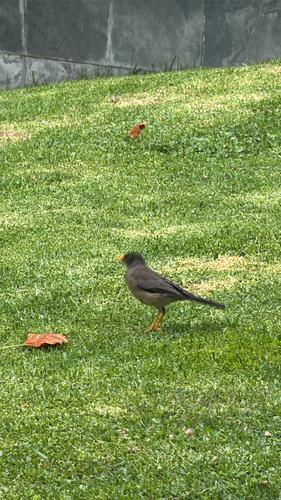
Austral Thrush
Turdus falcklandii
The austral thrush is 23 to 26.5 cm (9.1 to 10 in) long and weighs 95 to 113 g (3.4 to 4.0 oz). The sexes have the same plumage. Adults of the nominate subspecies have a mostly blackish brown head with a thin orange-yellow eye-ring and a buffy and blackish stippled chin and throat. Their upperparts, wings, and tail are warm brownish olive and their underparts ochre. Both sexes have a dark iris and an orange-yellow bill, legs, and feet. Juveniles have the same warm brownish olive upperparts as adults but with heavy buff streaks. Their underparts are buff-yellow with dark brown spots. Voice: Only male austral thrushes are known to sing. Individuals have a large repertoire consisting of "phrases of whistled and screeching syllables produced at a regular tempo". Older individuals tend to have more songs. The austral thrush is also an accomplished mimic and is known to imitate the songs of at least 12 species including songbirds and raptors.
ID text from Wikipedia, CC BY-SA 4.0

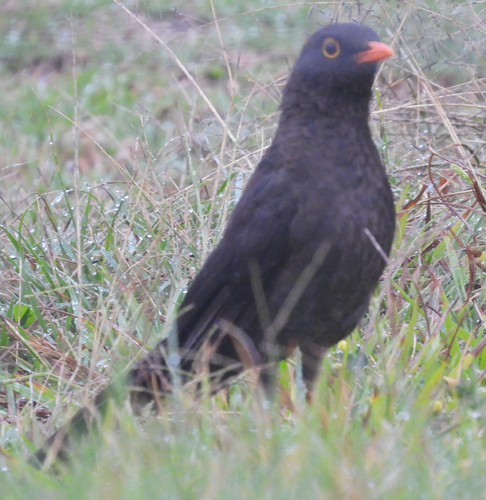
Great Thrush
Turdus fuscater
Adults are 28 to 33 cm (11 to 13 in) in length and weigh 128 to 175 g (4.5 to 6.2 oz), averaging 141 g (5.0 oz), making the species the largest member of the wide-ranging Turdus genus, and one of the largest thrushes although the Amami thrush may match or exceed it in size. It can be easily identified by its yellowish-orange beak and legs and yellow ring around the eye. Slight sexual dimorphism is sometimes present, with males having more strongly coloured legs and eye rings. Tail feathers are long. The plumage is black-brown, darker on wings and tail and pale on the belly.
ID text from Wikipedia, CC BY-SA 4.0

Learn this pair in the BeakBrain App
Photo and call practice. Coming soon to iPhone and Android.
Play today's Daily BirdPhotos and recordings are credited to their authors under the licence shown. Full profiles: Austral Thrush and Great Thrush.