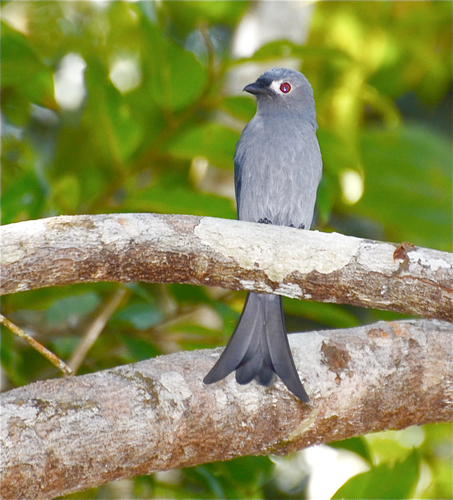
Ashy Drongo
Dicrurus leucophaeus
The adult ashy drongo is mainly dark grey, and the tail is long and deeply forked, There are a number of subspecies varying in the shade of the grey plumage. Some subspecies have white markings on the head. Young birds are dull brownish grey. Subspecies longicaudatus of India (which includes beavani of the Himalayas that winters on the peninsula, with one breeding population in central India that Vaurie separates as longicaudatus in the restricted sense) is very dark and almost like the black drongo although this bird is slimmer and has a somewhat longer and less-splayed tail.
ID text from Wikipedia, CC BY-SA 4.0

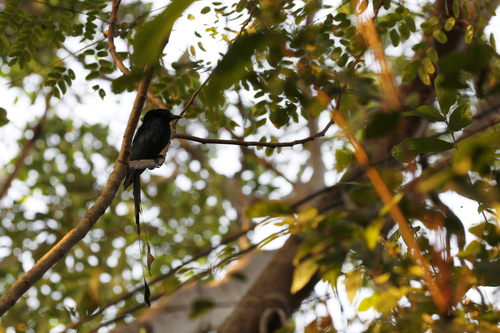
Greater Racket-tailed Drongo
Dicrurus paradiseus
In most of its range in Asia, this is the largest of the drongo species and is readily identifiable by the distinctive tail rackets and the crest of curled feather that begin in front of the face above the beak and along the crown to varying extents according to the subspecies. The tail with twirled rackets is distinctive and in flight it can appear as if two large bees were chasing a black bird. In the eastern Himalayas the species can be confused with the lesser racket-tailed drongo, however the latter has flat rackets with the crest nearly absent.
ID text from Wikipedia, CC BY-SA 4.0

Where you might meet both
Learn this pair in the BeakBrain App
Photo and call practice. Coming soon to iPhone and Android.
Play today's Daily BirdPhotos and recordings are credited to their authors under the licence shown. Full profiles: Ashy Drongo and Greater Racket-tailed Drongo.