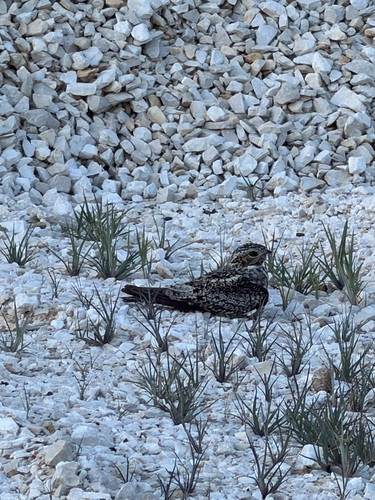
Antillean Nighthawk
Chordeiles gundlachii
The adults are dark with brown, grey and white patterning on the upperparts and breast; the long wings are black and show a white bar in flight. The tail is dark with white barring; the underparts are white with black bars. The adult male has a white throat; the female has a light brown throat. The most distinguishing characteristic to determine its identity from its closest relative the common nighthawk are the contrasting pale tertials near the back of the wings of a sitting bird. There are two color morphs, a gray and a rufous type. Voice: The call is a short pikadik usually heard overhead. The common nighthawk occasionally will make a similar call, but it is not as consistent. In the Dominican Republic, the bird is called querebebé; in Puerto Rico, the bird is called querequequé. Both are onomatopoeic terms which originate in Taíno.
ID text from Wikipedia, CC BY-SA 4.0

Sand-colored Nighthawk
Chordeiles rupestris
The sand-colored nighthawk is 20.5 to 22 cm (8.1 to 8.7 in) long. Its upperparts are pale grayish brown with darker brown streaks, bars, and spots. The chin and throat are white to buffy white, the breast grayish white with a cinnamon tinge and brown bars and spots, and the belly white with brown spots on its upper part. The underside of the wing is also mostly white. Voice: The sand-colored nighthawk apparently seldom sings, but it does so from the ground, "a gurgling purr...interspersed with quiet throat-clearing sound and loud grawh notes." It also makes a variety of other vocalizations when chasing another bird or defending a nest.
ID text from Wikipedia, CC BY-SA 4.0
Where you might meet both
Learn this pair in the BeakBrain App
Photo and call practice. Coming soon to iPhone and Android.
Play today's Daily BirdPhotos and recordings are credited to their authors under the licence shown. Full profiles: Antillean Nighthawk and Sand-colored Nighthawk.