
American Yellow Warbler
Setophaga aestiva
Other than in male breeding plumage and body size, all warbler subspecies are very similar. Winter, female and immature birds all have similarly greenish-yellow uppersides and are a duller yellow below. Young males soon acquire breast and, where appropriate, head coloration. Females are somewhat duller, most notably on the head. In all, the remiges and rectrices are blackish olive with yellow edges, sometimes appearing as an indistinct wing-band on the former. The eyes and the short thin beak are dark, while the feet are lighter or darker olive-buff. The 35 subspecies of S. Voice: The song is a musical strophe that can be rendered sweet sweet sweet, I'm so sweet, although it varies considerably between populations. The call is a soft or harder chip or ship. This is particularly frequently given by females after a male has finished his song. In territorial defense, they give hissing calls, while seet seems to be a kind of specialized cowbird alert (see below).
ID text from Wikipedia, CC BY-SA 4.0

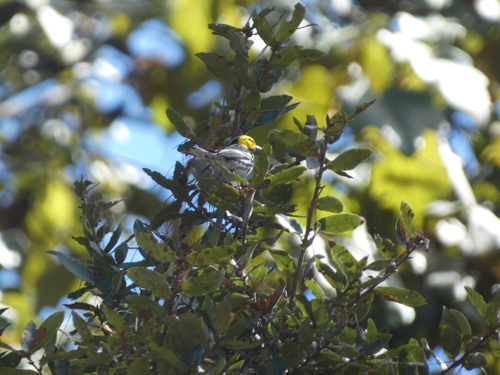
Golden-cheeked Warbler
Setophaga chrysoparia
The golden-cheeked warbler is very striking due to its bright yellow cheeks that are contrasted by its black throat and back. It is also identified by its unique buzzing song emerging from the wooded canyons where it breeds. Golden-cheeked warblers breed in 33 counties in central Texas and are dependent on ashe juniper (blueberry juniper or cedar) for their fine bark strips used as nesting material.
ID text from Wikipedia, CC BY-SA 4.0

Where you might meet both
Learn this pair in the BeakBrain App
Photo and call practice. Coming soon to iPhone and Android.
Play today's Daily BirdPhotos and recordings are credited to their authors under the licence shown. Full profiles: American Yellow Warbler and Golden-cheeked Warbler.