
Amazonian Pygmy Owl
Glaucidium hardyi
Voice: The main call of the Amazonian pygmy owl consists of repeated, short, high-pitched tweets.
ID text from Wikipedia, CC BY-SA 4.0
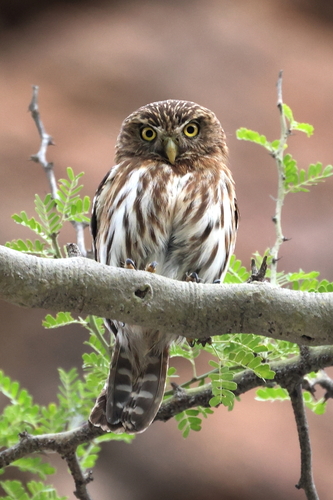
Pacific Pygmy Owl
Glaucidium peruanum
The Pacific pygmy owl is 15 to 17 cm (5.9 to 6.7 in) long. Males weigh about 60 g (2.1 oz) and females about 65 g (2.3 oz). In addition to being heavier, females also have slightly longer wings and tails than males, but both sexes have the same plumage. The species has gray, brown, and rufous color morphs, with the first two predominating. The upperparts of gray morph adults are grayish brown with buff streaks on the forecrown and buff spots on the crown and nape. An incomplete white "collar" and oval black spots on the neck give the appearance of eyes. Voice: The Pacific pygmy owl's song has been described as "a series of rapidly delivered pü notes" and also as "rapid...rising hoots: poop'poop'poop'poop....." It also makes "chirping and thin warbling notes." Vocal differences enable it to be separated from the similar Yungas pygmy owl (G. bolivianum) where their ranges overlap.
ID text from Wikipedia, CC BY-SA 4.0

Where you might meet both
Learn this pair in the BeakBrain App
Photo and call practice. Coming soon to iPhone and Android.
Play today's Daily BirdPhotos and recordings are credited to their authors under the licence shown. Full profiles: Amazonian Pygmy Owl and Pacific Pygmy Owl.