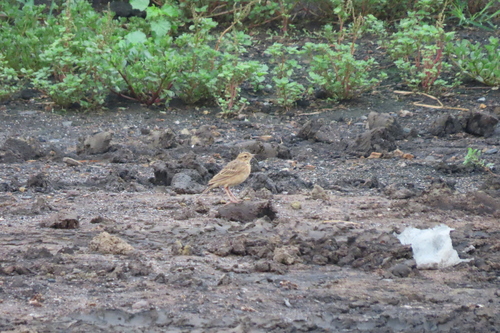
African Pipit
Anthus cinnamomeus
The African pipit is 15 to 17 cm (5.9 to 6.7 in) long and is a slender bird with an erect stance. It is buffy-brown above with darker streaks. The underparts are white or pale buff with a streaked breast and plain belly and flanks. The face is boldly patterned with a pale stripe over the eye and a dark malar stripe. The outer tail-feathers are white. The legs are long and pinkish and the slender bill is dark with a yellowish base to the lower mandible. Juvenile birds have a blotched breast, scalloping on the upperparts and some streaking on the flanks.
ID text from Wikipedia, CC BY-SA 4.0

Water Pipit
Anthus spinoletta
The water pipit is 15–17 centimetres (5.9–6.7 in) long and weighs 18.7–23 grams (0.66–0.81 oz). The adult of the nominate race in spring plumage has greyish-brown upperparts, weakly streaked with darker brown, and pale pink-buff underparts fading to whitish on the lower belly. There may be some faint streaking on the breast and flanks. The head is grey with a broad white supercilium. The outer tail feathers are white, and the legs, bill and iris are dark brown or blackish. In non-breeding plumage, the head is grey-brown and the supercilium is less distinct. Voice: The water pipit's song is delivered from a perch or in flight, and consists of four or five blocks, each consisting of about half a dozen repetitions of a different short note. In comparison, the European rock pipit's song is a sequence of about twenty tinkling cheepa notes followed by a rising series of thin gee calls, and finishing with a short trill.
ID text from Wikipedia, CC BY-SA 4.0

Where you might meet both
Learn this pair in the BeakBrain App
Photo and call practice. Coming soon to iPhone and Android.
Play today's Daily BirdPhotos and recordings are credited to their authors under the licence shown. Full profiles: African Pipit and Water Pipit.