
Acadian Flycatcher
Empidonax virescens
Adults have olive upperparts, darker on the wings and tail, with whitish underparts; they have a white eye ring, white wing bars and a wide bill. The breast is washed with olive. The upper part of the bill is dark; the lower part is yellowish. This bird's song is an explosive peet-sa. The call is a soft peet. They also have a call similar to that of the northern flicker. A unique two-note song described as "ka-zeep" helps to identify this species. Measurements: Length: 5.5–5.9 inches (14–15 cm) Weight: 0.4–0.5 ounces (11–14 g) Wingspan: 8.7–9.1 inches (22–23 cm)
ID text from Wikipedia, CC BY-SA 4.0

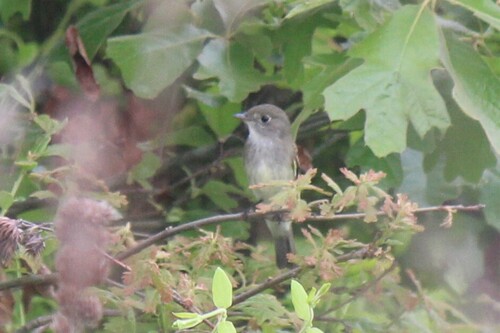
Alder Flycatcher
Empidonax alnorum
E. alnorum is one of the larger Empidonax species, attaining a length of 13–17 cm (5.1–6.7 in), and a weight of 12–14 g (0.42–0.49 oz). The wingspan ranges from 21–24 cm (8.3–9.4 in). The upperparts of E. alnorum are dull greenish-olive. The crown is a slightly darker olive-green than the back. The throat is white, with a darker breast band. Thin white rings surround the eyes. The bill is wide and moderate in length, with pinkish or yellow-orange lower mandible and black upper mandible. Wings are generally black, with white wing bars and white edges of the innermost secondaries (tertials). Voice: The vocalizations of the alder flycatcher are very useful for its identification in the field. The song is a distinct "fee-bee-o"; birds have been observed to throw their heads back and shake their tails while singing. There are a variety of calls made, the most common of which is a "pit" sound produced when foraging.
ID text from Wikipedia, CC BY-SA 4.0

Where you might meet both
Learn this pair in the BeakBrain App
Photo and call practice. Coming soon to iPhone and Android.
Play today's Daily BirdPhotos and recordings are credited to their authors under the licence shown. Full profiles: Acadian Flycatcher and Alder Flycatcher.